Category: Uncategorized

  • Regents Physics Exam June 2022 Questions and Solutions

    1. 1  Which terms identify two scalar quantities?
      (1) force and acceleration
      (2) impulse and distance
      (3) mass and velocity
      (4) energy and time

      Solution: Neither energy nor time has directions. Therefore, they are both scalar quantities. Choice (4)

    2 A motorcyclist, initially traveling east at 15 meters per second, accelerates uniformly at a rate of 3.0 meters per second squared east to a velocity of 21 meters per second east. How far does the motorcyclist travel while accelerating?
    (1) 1.0 m (2) 2.0 m (3) 36 m (4) 72 m

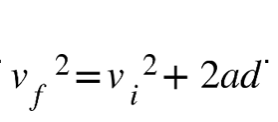
    Solution: Use the formula Vf2=vi2+2ad , we can solve for distance by plugging in initial and final velocities (15m/s and 21m/s, respectively) and the acceleration (3m/s^2). d = 36m. Choice (3)

    3 A battery-powered electric motor is used to cause the wheels of a toy car to rotate. In this motor, there is a conversion of
    (1) mechanical energy to electric energy
    (2) electric energy to chemical energy
    (3) thermal energy to electric energy
    (4) electric energy to mechanical energy

    Solution: The point of a battery powered motor is to use the energy stored in the battery and turn something such as wheels. This is a conversion from electric energy to mechanical energy. Choice (4)

    4 A projectile is launched horizontally from a height of 65 meters with an initial horizontal speed of 35 meters per second. What is the projectile’s horizontal speed after it has fallen 25 meters? [Neglect friction.]
    (1) 22 m/s (2) 35 m/s (3) 41 m/s (4) 280 m/s

    Solution:Remember, there is no acceleration in the horizontal direction, the horizontal speed must always remain the same. Choice (2)

    5 The diagram below represents two forces, F1 and F2, acting concurrently on a block sliding on a horizontal, frictionless surface.
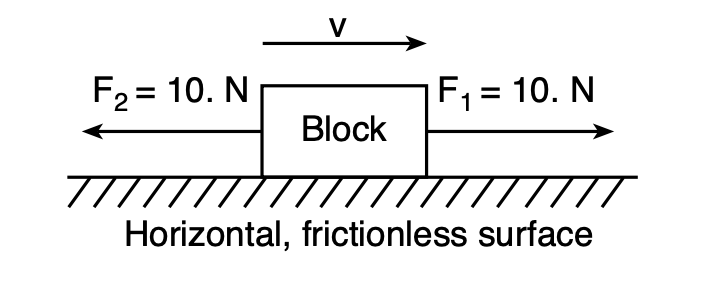
    Which statement describes the motion of the block?
    (1) The block is accelerating to the right.
    (2) The block is accelerating to the left.
    (3) The block is moving to the right with constant speed.
    (4) The block is moving to the left with decreasing speed.

    Solution: There is no unbalanced force according to the free body diagram. Remember, Newton’s 2nd law states that a net force of zero will produce zero acceleration so it must be moving at a constant speed. Choice (3)

    6 The magnitude of an unbalanced force applied to a 4.0-kilogram crate is 10. newtons. If the magnitude of this applied unbalanced force is doubled, the inertia of the crate is
    (1) halved (3) doubled (2) unchanged (4) quadrupled

    Solution: The inertia of the crate is solely dependent on its mass. Doubling the unbalanced force won’t change the inertia. Choice (2)

    7 A 60.-kilogram man is pushing a 30.-kilogram lawn mower. Compared to the magnitude of the force exerted on the lawn mower by the man, the magnitude of the force exerted on the man by the lawn mower is
    (1) one-quarter as great (3) the same (2) one-half as great (4) twice as great

    Solution: According to Newton’s 3rd law, for every action, there is an equal but opposite reaction. Choice (3)

    8 The diagram below represents a roller coaster car traveling counterclockwise in a vertical circle.
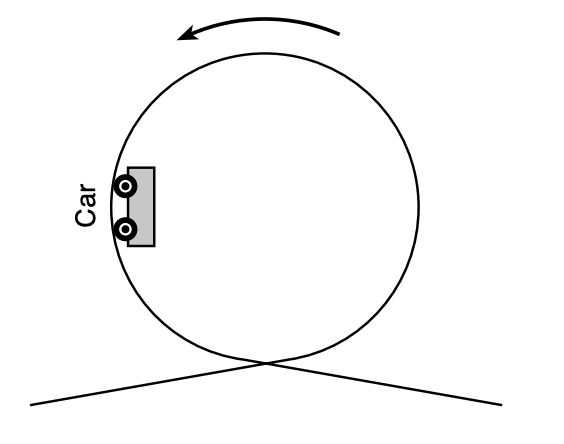
    When the car is in the position shown, what are the directions of the centripetal force acting on the car and the velocity of the car?
    (1) The centripetal force is directed to the right and the velocity is directed downward.
    (2) The centripetal force is directed downward and the velocity is directed to the right.
    (3) The centripetal force and velocity are both directed to the right.
    (4) The centripetal force and velocity are both directed downward.

    Solution: The velocity of an object going through uniform circular motion is always tangent to the circular path and the acceleration must be pointing towards the center of the circular path. Choice (1)

    9 An electric motor with a power rating of 6.48 * 104 watts is used to raise an elevator weighing 2.80 * 104 newtons at constant speed. What is the total time required for the motor to raise the elevator a vertical distance of 20.0 meters?
    (1) 0.116 s (3) 8.64 s (2) 2.31 s (4) 46.3 s

    Solution: Use the formula P= Fd/t, we can isolate for the time by plugging in F=2.8*10^4N, d=20m, and P=6.48*10^4 W. t= 8.64s. Choice (3)

    10 A person standing on a sidewalk hears the siren of an ambulance as it approaches, passes by, and goes away from the person. Compared to the frequency of the sound emitted by the siren, the frequency of the sound observed by the person during this event is
    (1) higher, only
    (2) lower, only
    (3) first higher and then lower
    (4) first lower and then higher

    Solution: This question deals with Doppler effect, as a source is approaching a stationary observer, the frequency observed will increase as the wave fronts are becoming closer and closer together while the wave fronts will spread apart as the source is moving away from the observer. Choice (3)

    11 Which particles exhibit properties of waves in some experiments?
    (1) photons, only
    (2) electrons, only
    (3) both photons and electrons
    (4) neither photons nor electrons

    Solution: Both photons and electrons exhibit wave properties as they can both be diffracted. Choice (3)

    12 The direction of the electric fi eld at a point in space is defi ned as the direction of the force exerted by the field on a
    (1) test mass located at that point
    (2) magnetic north pole located at that point
    (3) negative test charge located at that point
    (4) positive test charge located at that point

    Solution: The direction of the electric field is the direction of the force exerted on a positive test charge. Choice (4)

    13 A net force of one newton will
    (1) accelerate a 1-kg mass at 1.0 m/s2
    (2) accelerate a 1-kg mass at 9.8 m/s2
    (3) lift a l-kg mass vertically at a constant speed of 1.0 m/s
    (4) lift a 1-kg mass vertically at a constant speed of 9.8 m/s

    Solution: Using Newton’s 2nd law, Fnet=ma , we can see that 1N of force will accelerate 1kg of mass by 1m/s^2. Choice (1)

    14 The elongation of a spring will be quadrupled if the magnitude of the force elongating the spring is
    (1) quartered (3) doubled (2) halved (4) quadrupled

    Solution:Using the formula Fs=Kx , when x quadruples, the F must quadruple as well. Choice (1)

    15 The vector diagram below represents the path and distances run by a student in a cross-country race.
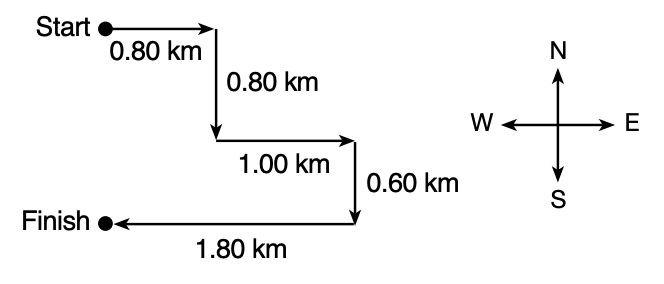
    The displacement of the student from start to finish is
    (1) 1.40 km north (3) 5.00 km north (2) 1.40 km south (4) 5.00 km south

    Solution: Displacement is a vector that connects the starting point to the end point. In this case, the end point is exactly 1.4km south of the starting point. Choice (2)

    16 The diagram below shows the arrangement of three charged hollow metal spheres, A, B, and C. The arrows indicate the direction of the electric forces acting between the spheres.
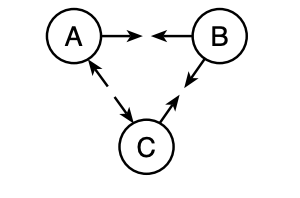
    What spheres have static charges of the same sign?
    (1) A and B, only (3) B and C, only (2) A and C, only (4) A, B, and C

    Solution: A charge will attract an opposite charge or something neutral while it is always repelled by the same charge. Choice (2)

    17 Two small charged spheres are located distance d from each other and experience an electrostatic force of attraction, Fe. If the magnitude of charge of each sphere is tripled and Fe is unchanged, what other change must have occurred?
    (1) The signs of both charges are changed.
    (2) The sign of only one charge is changed.
    (3) Distance d was increased by a factor of three.
    (4) Distance d was increased by a factor of nine.


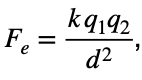
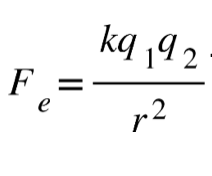
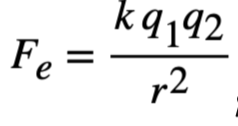
    Solution: Remember the formula for electrostatic force between point charges is , if both q1 and q2 were tripled and yet the F stayed the same, r must be tripled as well. Choice (3)
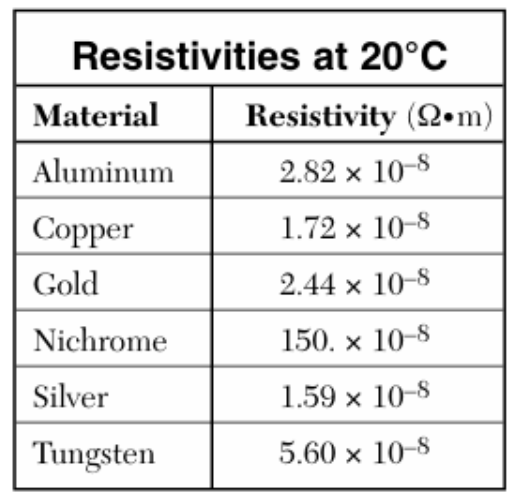
    18 Compared to the resistance of an aluminum wire at 20°C, the resistance of a tungsten wire of the same length and diameter at 20°C is approximately (1) the same (3) one-half as great (2) twice as great (4) four times as great
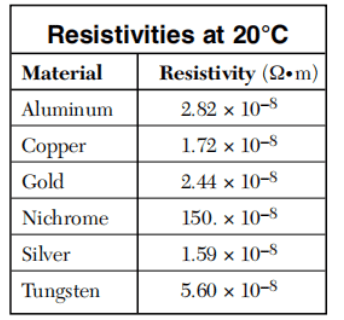
    Solution: from the table provided in the reference sheet, the resistance of aluminum should be ½ as great as the resistance of tungsten given that two objects have the same dimension. Choice (3)

    19 How much energy is expended when a current of 5.00 amperes is in a 5.00 ohm resistor for 5.00 seconds?
    (1) 25.0 J (3) 625 J (2) 125 J (4) 3130 J

    Solution: Using one of the Ohm’s laws, P=IV=I2R and the definition of power P=W/t, we can find the energy dissipated by the resistor by plugging in R=5Ω, t=5s and I=5A. We will get 25J. Choice (1)

    20 The amount of electric current through an unknown resistor may be measured by connecting
    (1) an ammeter in series with the resistor
    (2) an ammeter in parallel with the resistor
    (3) a voltmeter in series with the resistor
    (4) a voltmeter in parallel with the resistor

    Solution: To measure the current of a resistor, we must use an ammeter connected in series with the resistor. Choice (1)

    21 Which phenomenon represents a wave spreading out behind a barrier as the wave passes by the edge of the barrier?
    (1) diffraction (3) refl ection (2) refraction (4) interference

    Solution: The phenomenon where waves can pass through obstacles (such as a tiny hole) is called diffraction. Choice (1)

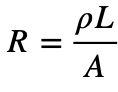
    22 A 1.00 kilometer length of copper wire, A, with a cross-sectional area of 1.00 * 10−4 meter squared has a resistance of 0.172 ohm at 20°C. Another copper wire, B, is half as long and has twice the cross-sectional area of wire A. What is the resistance of copper wire B at 20°C?
    (1) 0.0430 Ω (3) 0.172 Ω (2) 0.0860 Ω (4) 0.344 Ω

    Solution: Using the formula , if L is halved and A is doubled, the R is reduced by a factor of ¼. Choice (1)
    23 The magnitude of electric force exerted on a small positive charge located between two oppositely charged parallel plates is
    (1) smallest near the positive plate
    (2) smallest near the negative plate
    (3) greatest midway between the plates
    (4) the same everywhere between the plates

    Solution: The electric field between the parallel plates with the opposite charges is constant everywhere. Therefore the electrostatic force is constant everywhere between the plates as well. Choice (4)

    24 An acoustic organ is a musical instrument with pipes. The oscillation of air molecules in the pipes of the organ produces sound waves that are
    (1) electromagnetic and longitudinal
    (2) electromagnetic and transverse
    (3) mechanical and longitudinal
    (4) mechanical and transverse

    Solution: Organs produce sound waves which are mechanical (need the air molecules to propagate) and longitudinal. Choice (3)

    25 Which list identifi es portions of the electromagnetic spectrum in order of increasing frequency?
    (1) gamma ray, infrared, visible, ultraviolet
    (2) ultraviolet, visible, infrared, gamma ray
    (3) infrared, visible, ultraviolet, gamma ray
    (4) gamma ray, ultraviolet, visible, infrared
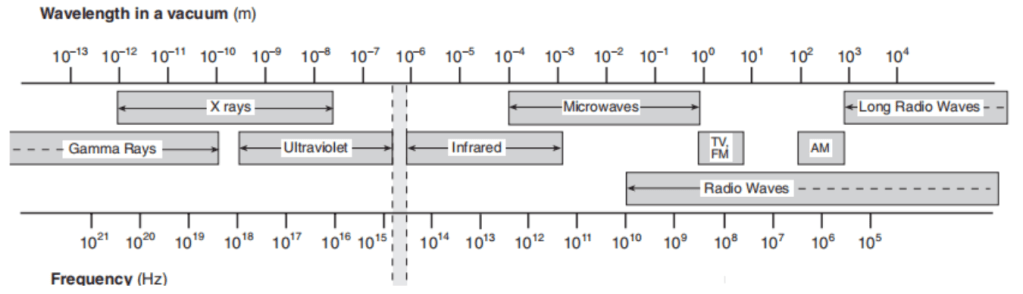
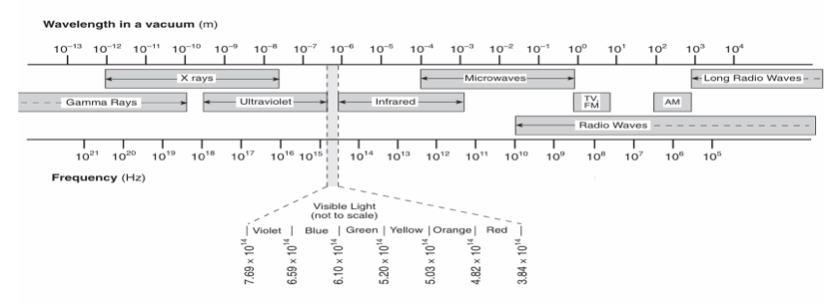
    Solution: Choice 3 is correct based on this chart. Choice (3)

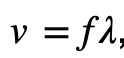
    26 A tuning fork is used to produce a sound wave having a frequency of 512 hertz. What is the wavelength of the sound wave in air at STP?
    (1) 0.646 m (3) 3.31 * 102 m (2) 1.55 m (4) 5.86 * 105 m

    Solution: The formula for the speed of a wave is , the speed of sound given in the reference sheet is 331m/s. We can find the wavelength by dividing 331m/s by 512Hz. Choice (1)
    27 An amplified sound wave produced by an opera singer shatters a glass. Which phenomenon best explains this event?
    (1) diffraction (3) refraction (2) reflection (4) resonance

    Solution: The phenomenon where the amplitude of vibration is amplified when the object is vibrated at its natural frequency is called resonance. Choice (4)

    28 The diagram below represents a wave traveling in a rope in the direction indicated.
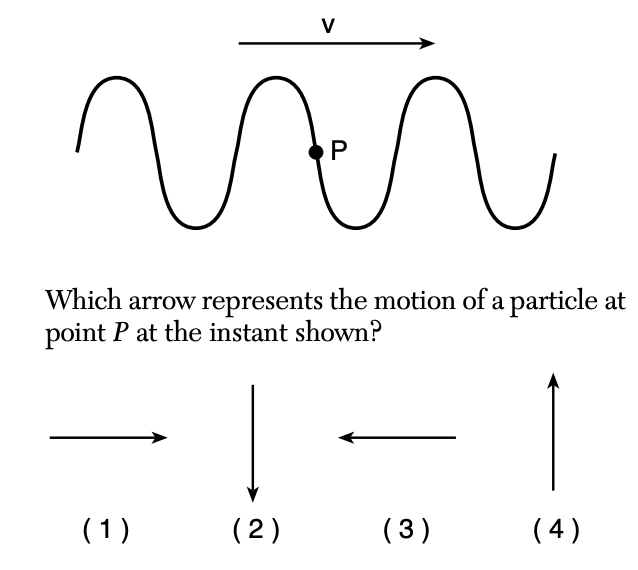
    Solution: We can find how the point P moves by back tracing along the wave against the direction of the wave. Choice (4)

    29 If several resistors are connected in series in an electrical circuit, the potential difference across each resistor
    (1) varies directly with the resistance of each resistor
    (2) varies inversely with the resistance of each resistor
    (3) varies inversely with the square of the resistance of each resistor
    (4) is independent of the resistance of each resistor

    Solution: When resistors are connected in series, they will have the same current. The potential difference across each one is given by Ohm’s law V=IR. Choice (1)

    30 In medium X, light with a wavelength of 3.44 * 10−7 meter travels at 2.20 *108 meters per second. In medium Y, this light has a wavelength of 3.12 * 10−7 meter. What is the speed of this light in medium Y?
    (1) 2.00 * 108 m/s (3) 2.43 * 108 m/s (2) 2.20 * 108 m/s (4) 3.00 * 108 m/s

    Solution: Remember that the frequency of the light stays the same no matter which medium you are in. Since the wavelength got shorter in medium Y, we expect Y to have a larger index of refraction than X and therefore a slower speed of light. Choice (1)

    31 A nuclear reactor produces 2.7 * 1016 joules of energy per year. How much mass is converted to energy by the reactor in one year?
    (1) 0.30 kg (3) 9.0 * 107 kg (2) 0.90 kg (4) 2.4 * 1033 kg

    Solution: We must use Einstein’s equation E=mc2 , we can obtain the mass by dividing the energy by speed of light in vacuum squared. m=0.3 kg. Choice (1)

    32 The diagram below shows the initial charge and position of two identical conducting spheres on insulating stands.
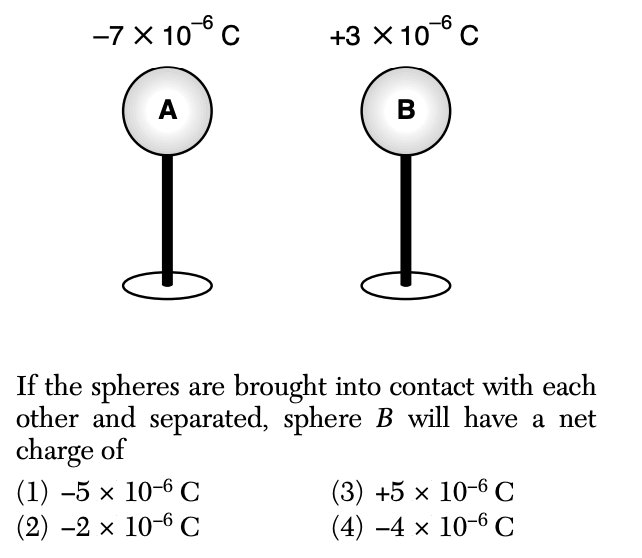
    Solution: Once the spheres come into contact with, the charges will evenly distribute between the two spheres. Choice (2)

    33 An antimuon neutrino is a
    (1) lepton with a −le charge
    (2) lepton with 0 charge
    (3) meson with a −le charge
    (4) meson with 0 charge

    Solution: An antimuon neutrino is the antiparticle of muon neutrino which happens to have zero charge (hence the same neutrino-little neutron) and is a lepton. Choice (2)

    34 The graphs below show the displacement of a certain particle in a medium versus time due to two periodic waves, A and B, traveling through the medium.
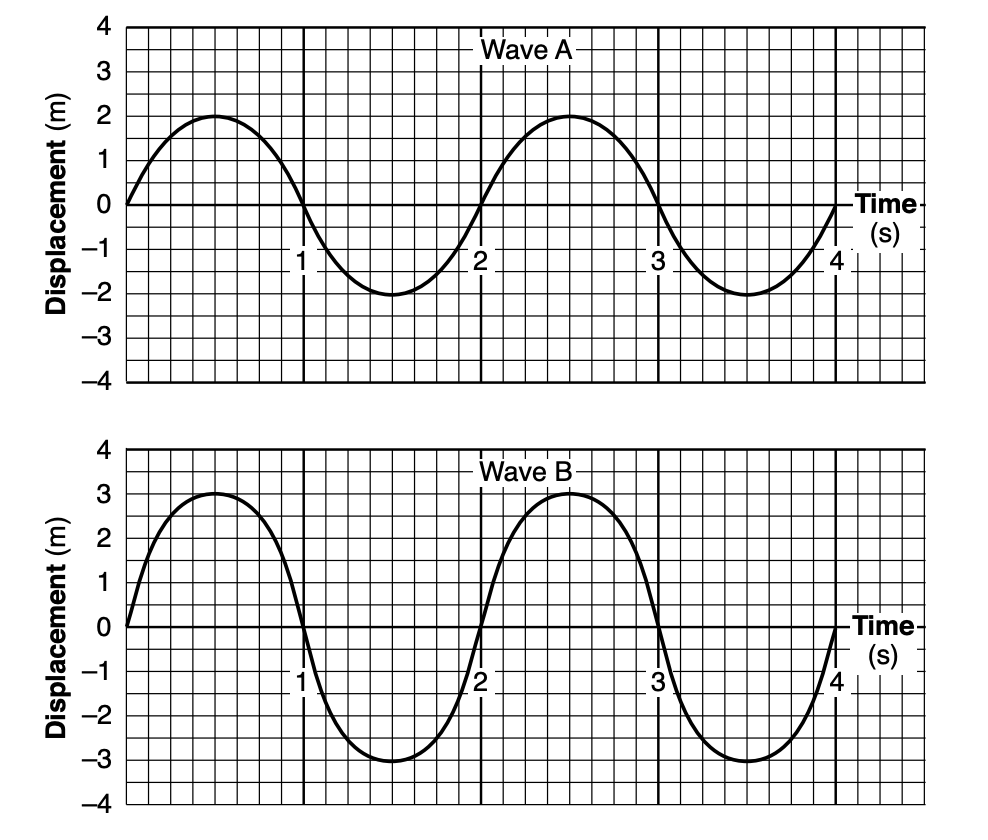
    The superposition of the two waves will cause the particle of the medium to have a maximum displacement of

    (1) 1.0 m (3) 2.5 m (2) 2.0 m (4) 5.0 m

    Solution: Wave A has an amplitude of 2m and Wave B has an amplitude of 3m, they are in phase so when they add, the amplitudes will add into 5m. Choice (4)

    35 The diagram below represents a wire that is not part of a complete circuit, just above the poles of two magnets.
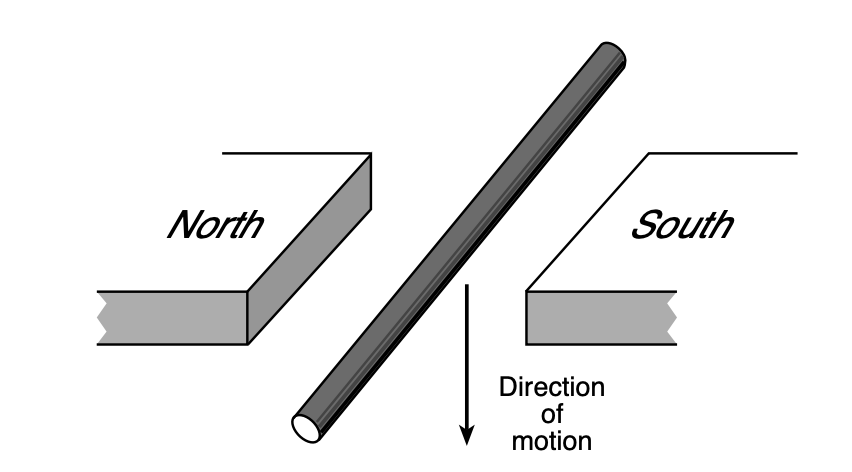
    Moving the wire downward between the poles in the direction shown in the diagram will
    (1) induce an alternating magnetic fi eld between the poles of the magnets (2) induce a potential difference between the ends of the wire
    (3) decrease the wire’s resistivity
    (4) reverse the direction of the magnetic field

    Solution: This scenario is where Faraday’s law becomes applicable. Choice (2)

    36 Which graph best represents the motion of an object traveling at a constant positive velocity?
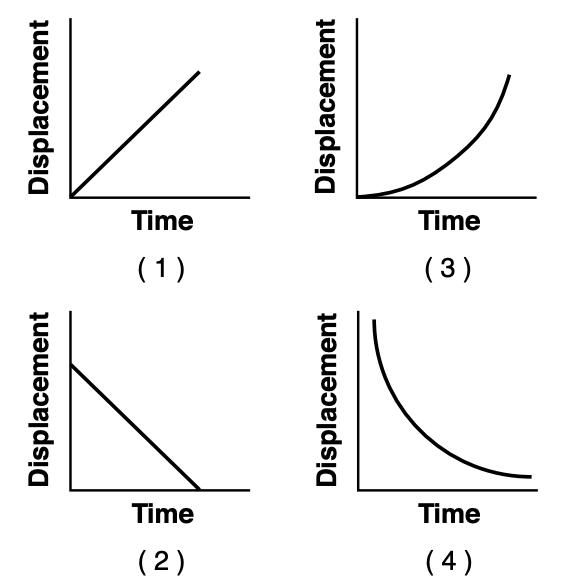
    Solution: A constant positive velocity will have a graph of displacement vs time graph that is linearly increasing. Choice (1)

    37 A cannonball is fi red with an initial velocity of 100. meters per second at an angle of 15.0° above the horizontal. What are the horizontal (vx) and vertical (vy) components of this velocity?
    (1) vx = 96.6 m/s, vy = 25.9 m/s
    (2) vx = 25.9 m/s, vy = 96.6 m/s
    (3) vx = 76.0 m/s, vy = 65.0 m/s
    (4) vx = 65.0 m/s, vy = 76.0 m/s

    Solution: We can find the v_x by 100m/s *cos(30) and v_y by 100m/s*sin(30). Choice (1)

    38 A 1200-kilogram car is moving at 10. meters per second when a braking force of 3000. newtons is applied. How much time is required to bring the car to rest?
    (1) 0.40 s (3) 25 s (2) 2.5 s (4) 4.0 s

    Solution: The force of breaking will create an acceleration of 3000N/1200kg= 2.5m/s^2. Keep in mind that this acceleration should be negative and we can use the formula Vf= vi+at, where the final velocity =0m/s and initial velocity = 10m/s. t=4s. Choice (4)

    39 Which graph best represents the relationship between the speed of light (f = 5.09 * 1014 Hz) in a transparent medium and the absolute index of refraction of the medium?
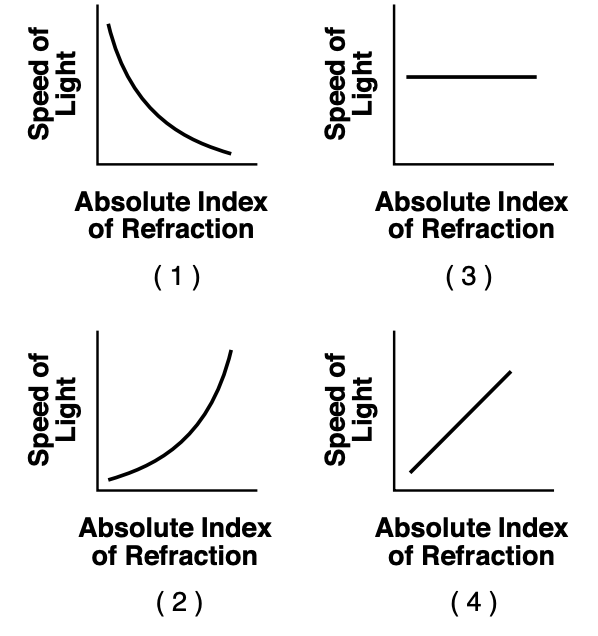
    Solution: Formula for speed of light is v=c/n , n is inversely proportional to v so graph 1 is the right choice. Choice (1)

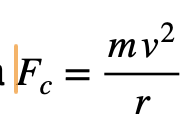
    40 A student uses a string to whirl a 0.25-kilogram mass in a horizontal circular path that has a 0.80-meter radius. If the magnitude of the centripetal force exerted on the mass with the string is 25 newtons, the speed of the mass is
    (1) 2.8 m/s (3) 11 m/s (2) 8.9 m/s (4) 80. m/s

    Solution: Use the formula , we can plug in 25N into Fc and 0.25kg into m and 0.8m into r. v= 8.94m/s. Choice (2)
    41 A deuteron is formed by combining a proton and a neutron. The mass of a deuteron is 2.39 * 10−3 universal mass unit less than the combined masses of a proton and a neutron. This mass difference is equivalent to
    (1) 2.56 * 10−6 MeV (3) 2.39 MeV (2) 2.23 MeV (4) 2.15 * 1014 MeV

    Solution: 1u = 931MeV. We can find the energy equivalent to this mass by doing 2.39*10^-3*931= 2.23MeV

    42 A gravitational force of magnitude F exists between Earth and a satellite on Earth’s surface. The satellite is sent into orbit at a distance of three Earth radii above Earth’s surface, as shown in the diagram below.
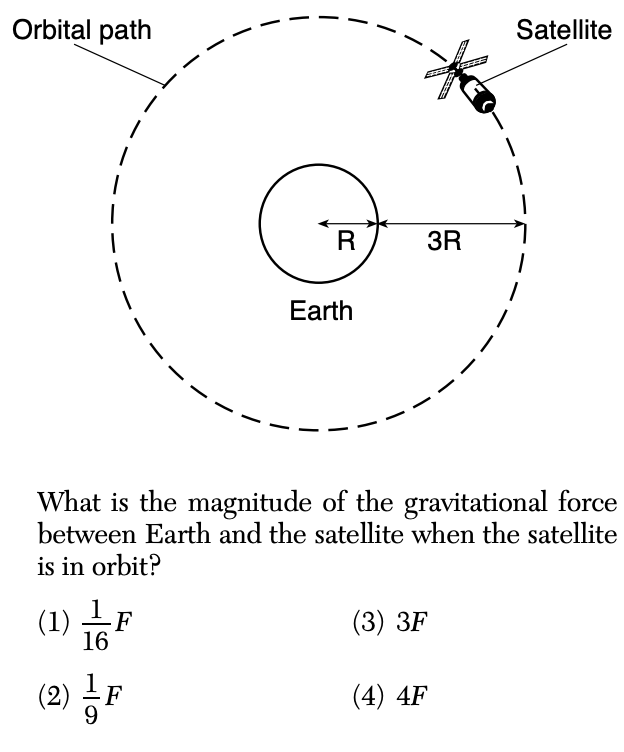
    Solution: Remember that the gravitational force is inversely proportional to square of r (distance between the centers of masses). The distance here increased bdy a factor of 4 so the force is only 1/16 of what it was on the surface of Earth. Choice (1)

    43 As part of an investigation on quantization, a student measured and recorded the mass of fi ve identical containers, each holding a different number of pennies. The table shows the student’s data.
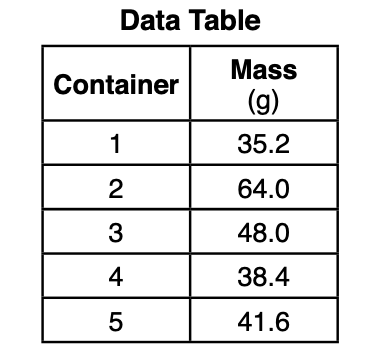
    Based on the data, what is the most likely mass of one penny?
    (1) 3.2 g (3) 9.6 g (2) 6.4 g (4) 12.8 g

    Solution: The smallest difference between the masses of the boxes is 3.2g so that should be the most likely number. Choice (1)

    44 Which graph represents the relationship between the frequency and period of a wave?
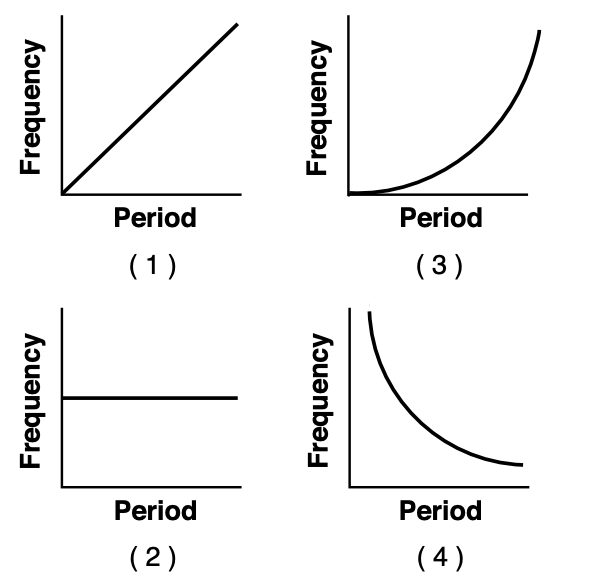
    Solution: Frequency and period are inversely proportional to each other so graph 4 is correct. Choice (4)

    45 What is the current in a conductor if 3.15 * 1018 electrons pass a given point in the conductor in 10. seconds?
    (1) 0.050 A (3) 0.50 A (2) 2.0 A (4) 0.20 A

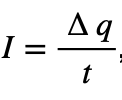
    Solution: , the charge is 3.15*10^18*1.6*10^-19= 0.504C. I should be 0.504C/10s = 0.0504A. Choice (1)
    46 A particle with a charge of +3.0 nanocoulombs is placed in an electric fi eld with a magnitude of 1500 newtons per coulomb. What is the magnitude of the electrostatic force exerted on the particle by the electric field?
    (1) 4.5 * 10−6 N (3) 4.5 * 1011 N (2) 5.0 * 102 N (4) 5.0 * 1012 N

    Solution: Use the formula E=F/q, we can find the force by letting q = 3*10^-9 C and E = 1500N/C. F= 4.5*10^-6N. Choice (1)

    47 The graph below represents the motion of an airplane that starts from rest and takes off from a straight runway.
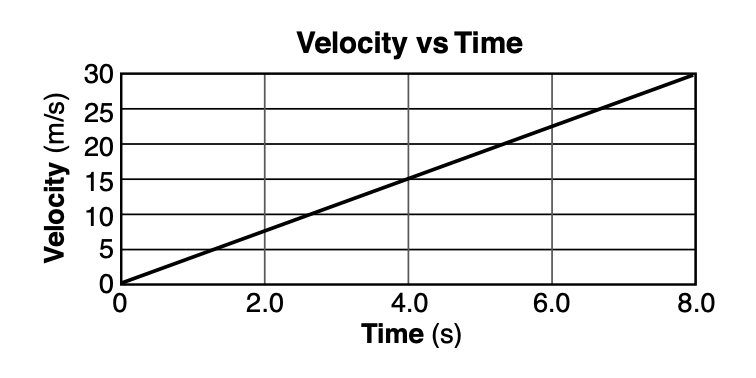
    Which quantity is represented by the slope of the graph?
    (1) total distance traveled (3) average speed (2) displacement (4) acceleration

    Solution: For velocity vs time graph, the slope represents the acceleration. Choice (4)

    48 The diagram below represents two horizontal platforms that are at different heights above level ground. A ball rolls off the taller platform with a horizontal speed of 15 meters per second and travels through the air, landing on the top of the shorter platform.
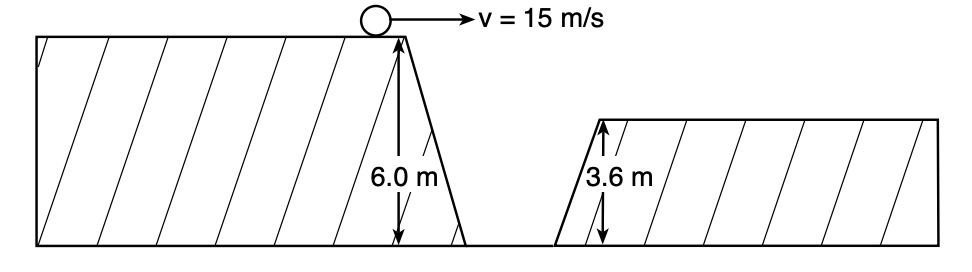
    What is the total time the ball is in the air? [Neglect friction.]
    (1) 0.16 s (3) 0.70 s (2) 0.49 s (4) 1.1 s


    Solution:

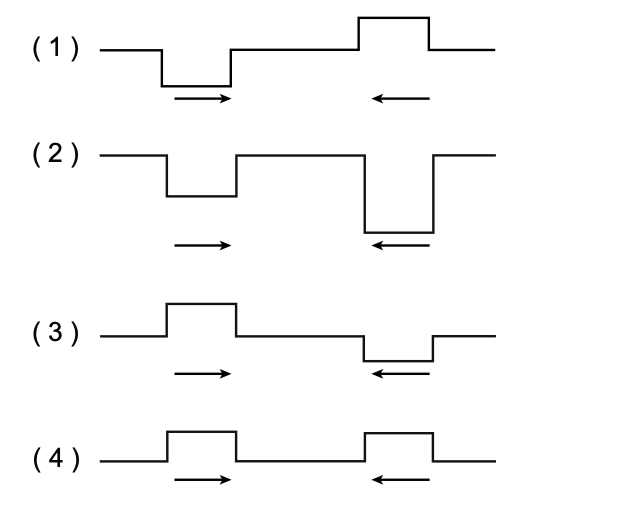
    49 Four mechanical waves are created in the same medium over the same time interval. Which diagram represents the wave that transfers the greatest amount of energy?
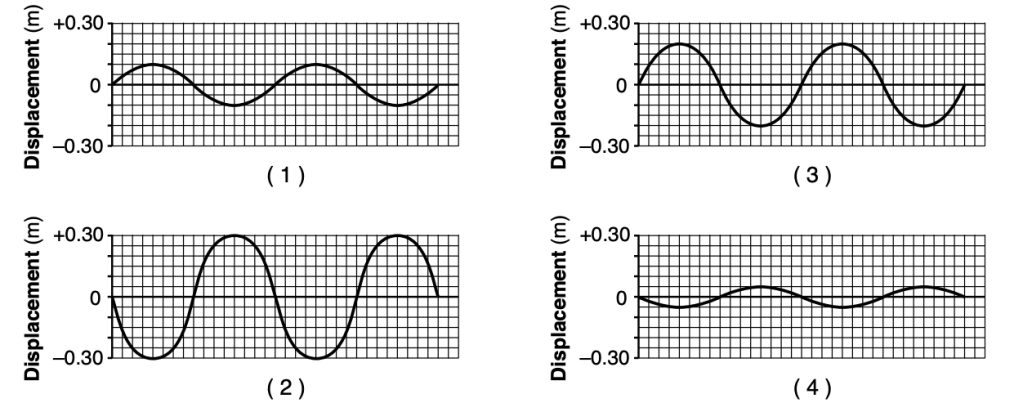
    Solution: Energy of a wave is proportional to the amplitude squared. Graph 2 has the greatest amplitude. Choice (2)

    50 Which diagram represents a light ray increasing in speed as it travels from one medium to another?
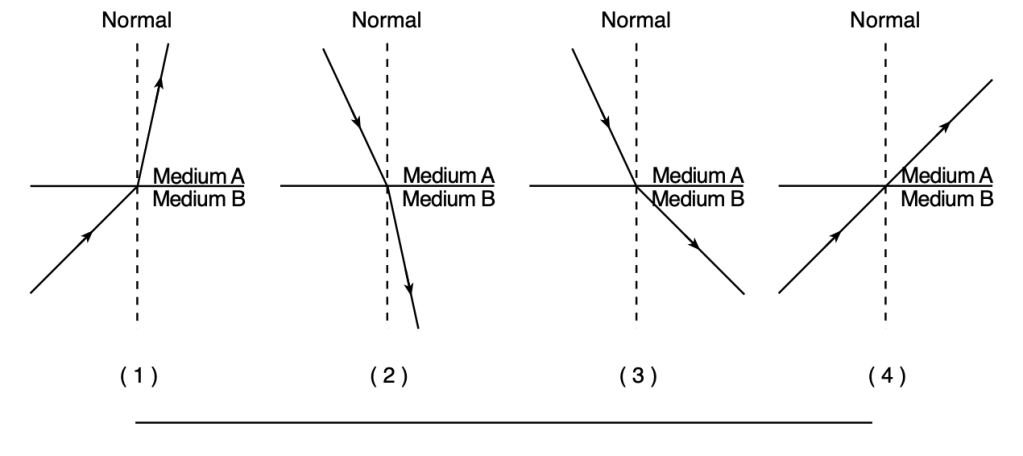

    Solution: If the speed of light increased after going into the 2nd medium, that must mean that the index of refraction is smaller. Based on Snell’s law, it must mean that the angle of refraction is bigger than the angle of incidence. Choice (3)
  • Regents Physics June 2023 Exam and Solutions

    1 Which pair of quantities are both scalar quantities?
    (1) speed and mass
    (2) speed and momentum
    (3) momentum and displacement
    (4) mass and displacement

    Solution: A scalar quantity cannot be expressed as a vector such that it can be oriented at a certain angle (e.g. 45 degrees with respect to x-axis). Momentum and displacement are both vector quantities. On the other hand, mass is a scalar quantity and so is speed (not velocity). Therefore, the correct choice is A Choice (1)


    2 In an attempt to get ketchup out of a bottle, a student takes off the cap, turns the bottle upside down, accelerates it downward, and then suddenly
    stops it. Ketchup is released from the open bottle because the ketchup doesn’t stop moving when the bottle does. The ketchup leaving the bottle illustrates
    (1) inertia
    (2) resistivity
    (3) resonance
    (4) mass being converted to energy

    Solution: The phenomenon being described here is similar to the thrust felt by the driver when he/she suddenly stops the car. According to Newton’s 1st law, things in motion tend to remain in that motion. The reason drivers feel the thrust is because their bodies aren’t moving in the same frame as the car. The tendency to remain in whatever motion there had been called “inertia”. Choice (1)


    3 The same net force is applied to object A and object B. The mass of B is three times greater than the mass of A. Compared to the acceleration of A,
    the acceleration of B is
    (1) the same
    (2) one-third as great
    (3) three times as great
    (4) one-ninth as great

    Solution: According to Newton’s 2nd law, Fnet=ma. For the same Fnet, having 3 more times the mass will mean the acceleration is only 1/3 of the other. Choice (2)


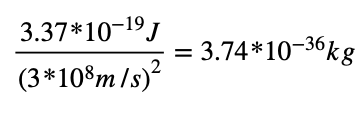
    4 What is the mass equivalent of 3.37 × 10⁻¹⁹ joule?
    (1) 1.26 × 10–54 kg (3) 1.12 × 10⁻²⁷ kg
    (2) 3.74 × 10–36 kg (4) 5.08 × 10¹⁴ kg

    Solution: This problem will require us to use the famous equation introduced by Einstein E=mc2 Choice (2)

    5 Which object is in equilibrium?
    (1) Earth orbiting the Sun
    (2) a thrown baseball at its highest point above the ground
    (3) a car moving at a constant speed in a straight line
    (4) a bicycle skidding to a stop in a straight line

    Solution: Something in equilibrium must have no unbalanced force and therefore it must be either stationary or moving at a constant velocity (not speed). While choice 1 seems promising, we must remember that when a planet is orbiting around the star, there is a centripetal force that’s keeping it in moving in a uniform circular motion. Choice 3 mentions that the object is moving at a constant velocity by saying that it’s moving at a constant speed in a linear manner. Choice (3)

    6 A race car travels around a flat circular track at
    constant speed. The net force on the car acts
    (1) perpendicular to the car’s velocity and toward the center of the circle
    (2) perpendicular to the car’s velocity and away from the center of the circle
    (3) parallel to the car’s velocity and in the same direction as the velocity
    (4) parallel to the car’s velocity and in the opposite direction as the velocity

    Solution: If something is undergoing uniform circular motion, the centripetal force must always be pointing towards the center of rotation and is always perpendicular to the velocity. Choice (1)


    7 An object is traveling in a horizontal, circular path at a constant speed. If the radius of the path were doubled while the speed remained constant, the centripetal acceleration would be
    (1) quartered (3) halved
    (2) doubled (4) quadrupled

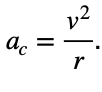
    Solution: The formula for centripetal acceleration is . When you increase r by a factor of 2 while keeping the velocity the same, the centripetal acceleration is halved. Choice (3)

    8 A 600.-newton student pushes on a vertical wall for 20.0 seconds with a constant force having a magnitude of 100. newtons. What is the magnitude
    of the force that the wall exerts on the student?
    (1) 0.00 N (3) 100. N
    (2) 5.00 N (4) 600. N

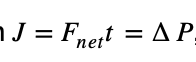
    Solution: This is a problem that we must argue using Newton’s 3rd law, for every action force, there is an equal but opposite reaction force. The action force here is the 100N force that the student is pushing the wall with, so reaction must be also 100N. Choice (3)


    9 An unbalanced force of 20. newtons is applied to a mass of 1.0 × 10³ kilograms. After 10. seconds, the momentum of the mass will have changed by
    (1) 2.0 × 10² kg•m/s (3) 1.0 × 10⁴ kg•m/s
    (2) 2.0 × 10³ kg•m/s (4) 2.0 × 10⁴ kg•m/s

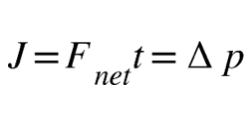
    Solution: Using the equation , we know that the mass had been rest before the force was applied so P_initial=0. Therefore, P_final=20N*10s=200 kg*m/s Choice (1)
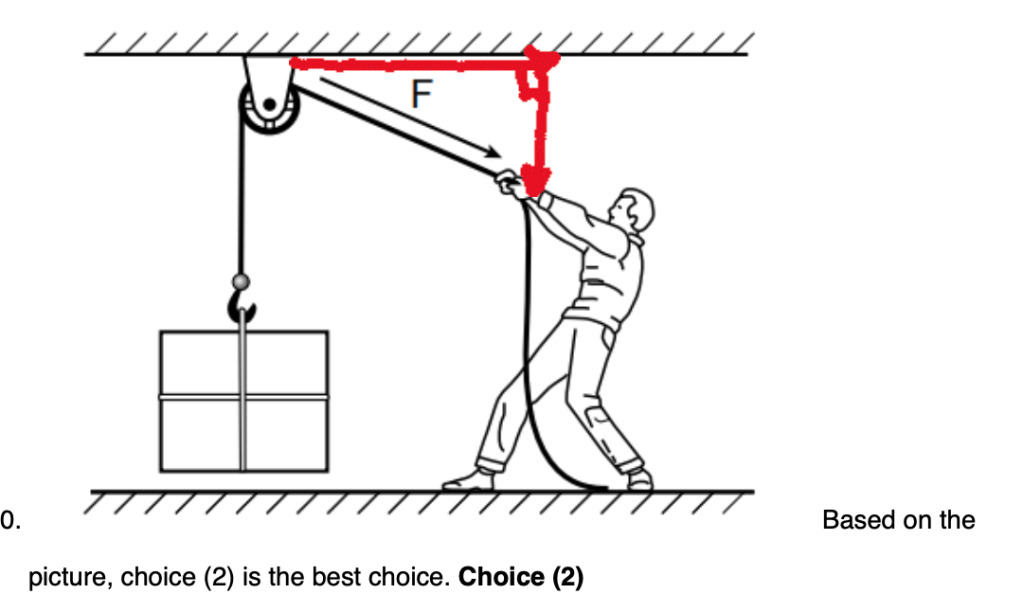
    10 To lift a heavy block off the floor, a student pulls with force F on a rope that passes over a pulley, as shown in the diagram below.

    Solution:

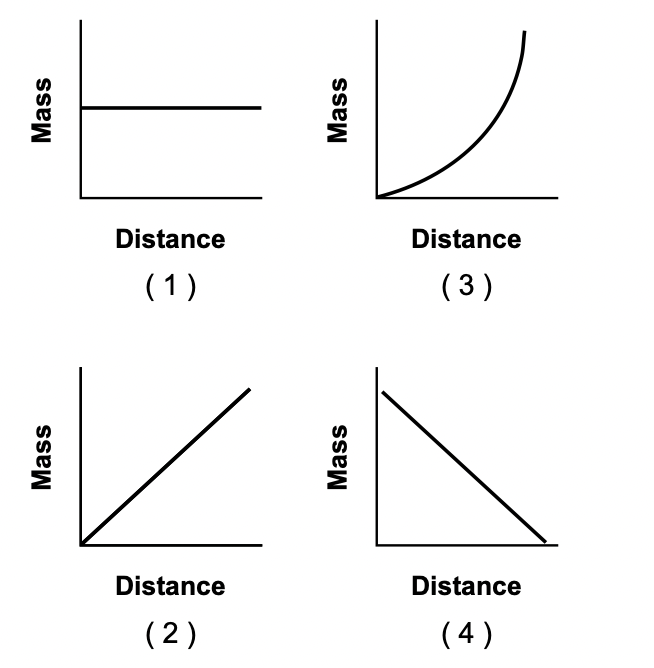
    11 Which graph best represents the relationship between the mass of an object and its distance from Earth’s surface?

    Solution: Remember, mass is a quantity that does not depend on the distance with anything such as a planet (Earth). Choice (1)

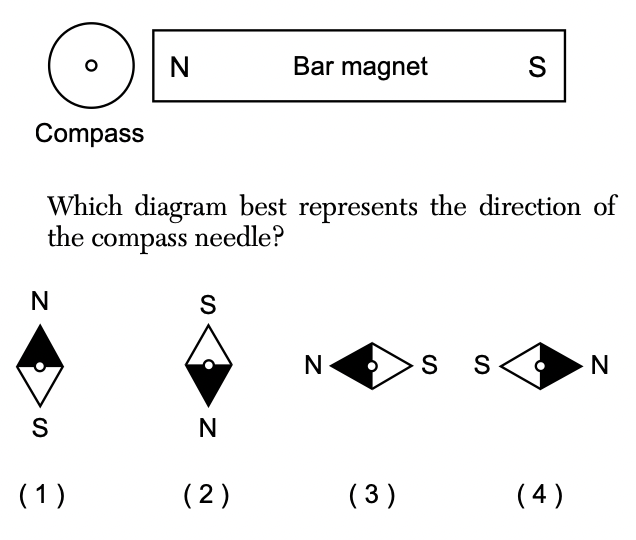
    12 A compass is placed near a strong bar magnet as represented in the diagram below.

    Solution: Since opposite poles attract, the south pole of the compass needle will be attracted to the north pole of the bar magnet. Choice (3)

    13 As Earth orbits the Sun in its elliptical orbit, the gravitational force between the Sun and Earth is
    (1) always attractive
    (2) attractive as the Sun and Earth get closer together and repulsive as the Sun and Earth get farther apart
    (3) repulsive as the Sun and Earth get closer together and attractive as the Sun and Earth get farther apart
    (4) always repulsive

    Solution: The gravitational force is always attractive. Choice (1)


    14 Which unit is used to measure the work per unit charge required to move a charge in an electric field?
    (1) ampere (3) volt
    (2) coulomb (4) watt

    Solution: Using the equation V= W/q, the unit of W is joules, the unit of q is coulomb, and the unit of V is volt. Choice (3)

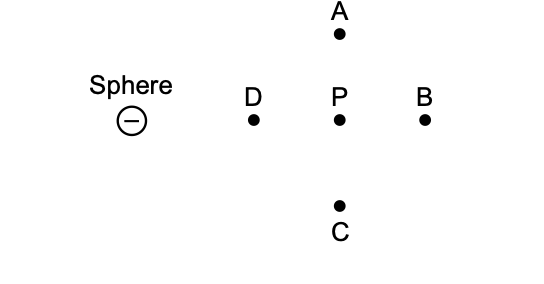
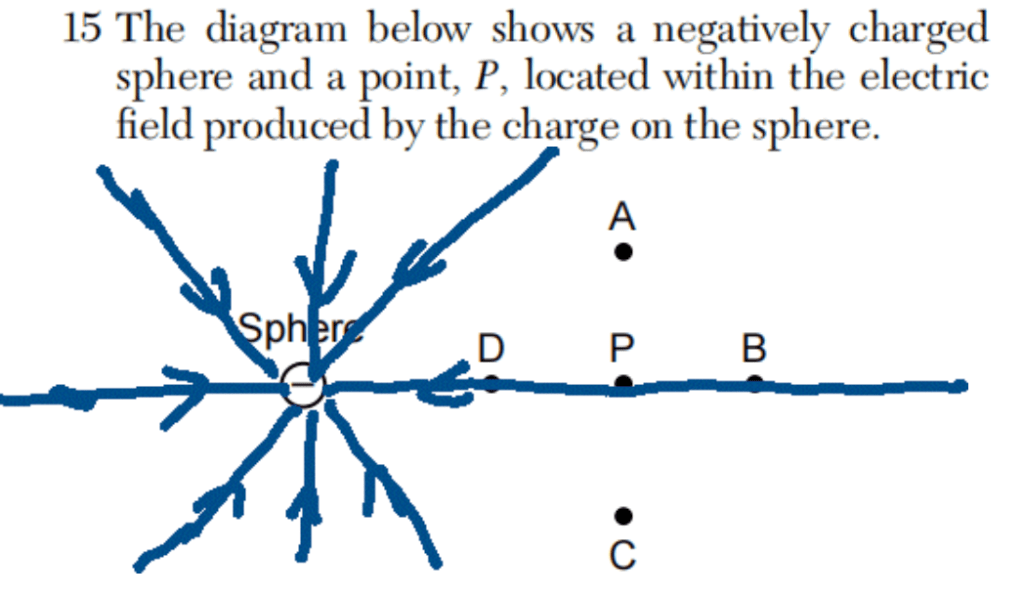
    15 The diagram below shows a negatively charged sphere and a point, P, located within the electric field produced by the charge on the sphere.

         The direction of the electric field at point P is
    

    toward point
    (1) A (3) C
    (2) B (4) D

    Solution: Remember that the electric field lines of a negative point charge must be radially pointing towards it. Choice (4)

    16 Two point charges, q1 and q2, are initially a distance, d, apart. Which change will cause the greatest increase in the electrostatic force between
    the two point charges, q1 and q2?
    (1) double q1 (3) double d
    (2) halve q2 (4) halve d

    Solution: Using the equation , if we halve the d, it will cause the force to quadruple whereas doubling d will cause it to be only ¼ of the original amount. On the other hand, if we double q1, it will only double the force and halving q2 will only halve the force. Choice (4)
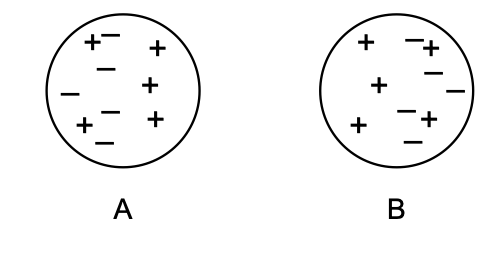
    17 The diagram below represents two identical conducting spheres.

         Which statement could be the correct explanation
    

    for the charge distribution on the spheres?
    (1) A small positively charged object is located between sphere A and sphere B.
    (2) A small negatively charged object is located between sphere A and sphere B.
    (3) A small positively charged object is located to the right of sphere B.
    (4) A small negatively charged object is located to the right of sphere B.

    Solution: More positive charges are distributed to the inner sides of the spheres and since opposite charges attract, there must be a negative charge between spheres A and B. Choice (2)

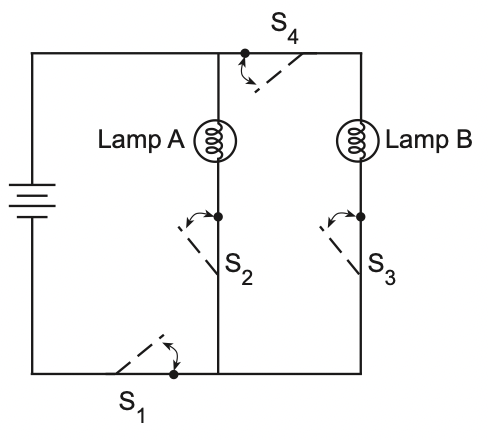
    18 The diagram below represents a circuit containing a battery, two operating lamps, A and B, and four closed switches, S1, S2, S3, and S4.

         Which switch, when opened, causes both lamps to
    

    turn off?
    (1) S1 (3) S3
    (2) S2 (4) S4

    Solution: Opening switch S1 will cause the currents through both light bulbs unable to come back to the battery. Choice (1)

    19 What is the resistance of a 100.-watt bulb when operating a potential difference of 120. volts?
    (1) 1.20 W (3) 120. W
    (2) 100. W (4) 144 W

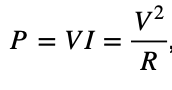
    Solution: Using Ohm’s law, , we can solve for the resistance R easily by plugging 100W into P and 120V into V, R=144Ω. Choice (4)
    20 The interaction that is most responsible for binding three quarks together in a proton is the
    (1) strong force (3) weak force
    (2) electromagnetic force (4) gravitational force

    Solution: The force that is responsible for holding nucleons (protons and neutrons) and the constituents of nucleons (quarks) is always the strong force. Choice (1)


    21 One example of a force doing work is the force exerted by
    (1) Earth on a high diver falling toward a pool from a platform above
    (2) a hook on an engine held stationary above a car
    (3) a frictionless horizontal air hockey table on a puck moving across the table at a constant velocity
    (4) a weightlifter on a barbell he holds motionless over his head

    Solution: The force applied will always do work unless the direction of displacement and the direction of the applied force is perpendicular. Both situations described by choices 2 and 3 have displacement being perpendicular to the force. For choice 4, the situation is that while the weightlifter is simply holding the barbell, the displacement is zero, so no work is done by the applied force (force of holding the barbell). For choice 1, the applied force is the force of gravity, and it is always in the same direction as falling. Choice (1)

    22 A ball falls freely from a rooftop to the street below. The ball starts from rest with 20. joules of gravitational potential energy with respect to the
    street. The total mechanical energy of the ball just before it hits the street is
    (1) 0 J (3) 10. J
    (2) 5.0 J (4) 20. J

    Solution: The total mechanical energy of the system is always conserved unless there is an external force being applied. Choice (4)


    23 Which statement describes the gravitational potential energy (PE), kinetic energy (KE), and internal (thermal) energy (Q), of a wooden crate
    as it is pushed across a level classroom floor at constant speed?
    (1) The PE decreases, KE remains the same, and Q decreases.
    (2) The PE increases, KE increases, and Q decreases.
    (3) The PE remains the same, KE decreases, and Q increases.
    (4) The PE remains the same, KE remains the same, and Q increases.

    Solution: As a piece of wood is being pulled across a level floor with the same velocity, the PE (due to gravity) will remain constant since the height is not changed, KE will also remain constant since the velocity is constant. However, the Q will increase as there is a friction force acting opposite to the applied force. Choice (4)


    24 The oscillation of electrons up and down a metal antenna produces waves. These waves are
    (1) mechanical and longitudinal
    (2) mechanical and transverse
    (3) electromagnetic and transverse
    (4) electromagnetic and longitudinal

    Solution: A charged particle moving under acceleration will always emit electromagnetic radiation. Choice (3)


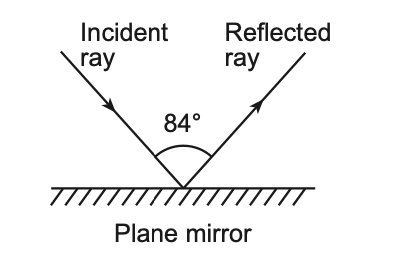
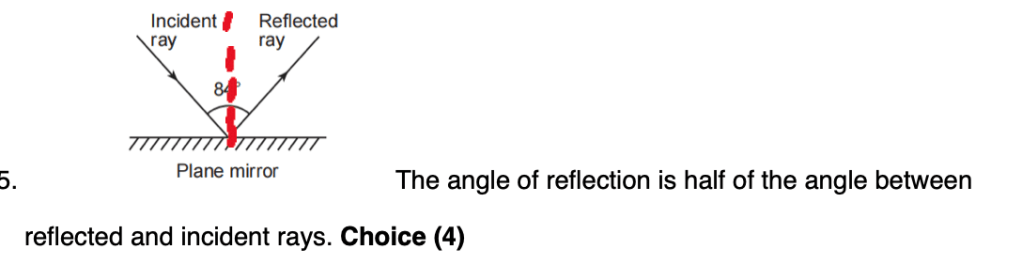
    25 The diagram below shows an incident light ray
    reflecting from a plane mirror.

         What is the angle of reflection?
    

    (1) 96° (3) 48°
    (2) 84° (4) 42°

    Solution:

    26 A characteristic common to both sound waves and x rays is that they both
    (1) travel fastest in a vacuum
    (2) cause particles to vibrate in a direction parallel to the wave’s direction of motion
    (3) transmit energy without transmitting matter
    (4) are mechanical

    Solution: Both sound waves and x-ray (EM wave) transmit energy without transmitting matters. Choice (3)


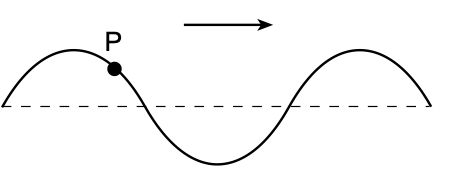
    27 The diagram below represents a wave moving to
    the right through a rope.

    Point P in the rope is moving toward the
    (1) top of the page (3) right
    (2) bottom of the page (4) left

    Solution: If we try to trace back (opposite to the direction of the velocity of the wave) point P along the curve, we see that it must go up. Choice (1)


    28 What is the wavelength of a 300.-hertz sound wave in air at STP?
    (1) 0.906 m (3) 3.00 × 10² m
    (2) 1.10 m (4) 1.00 × 10⁶ m

    Solution: Based on the reference table, the speed of sound is 331m/s and the formula we will use is where the f=300Hz. Solving for λ, we get 331/300=1.10m. Choice (2)
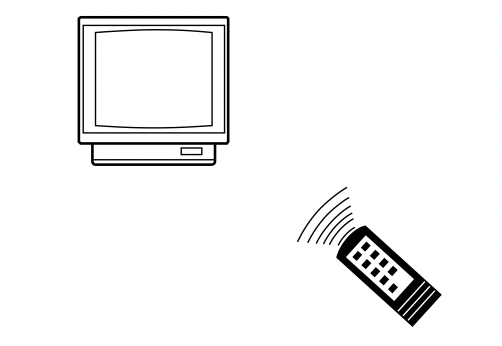

    29 In the diagram below, a remote control is aimed at
    a television.

    When the signal from the remote reaches the sensor on the television, the signal will most likely be
    (1) neither reflected nor absorbed
    (2) partially absorbed and partially reflected
    (3) completely reflected
    (4) completely absorbed

    Solution: Under normal circumstances, it is extremely unlikely that an incident (signal emitted out of the remote control) is entirely reflected or absorbed. Choice (2)

    30 Compared to waves of blue light traveling in a vacuum, waves of red light traveling in a vacuum have
    (1) a lower frequency and a lower speed
    (2) a lower frequency and the same speed
    (3) the same frequency and a lower speed
    (4) the same frequency and the same speed

    Solution: All EM waves will travel at c=3*10^8 m/s in vacuum. However, the red light has a longer wavelength than the blue light. Longer wavelength will imply that it must have a smaller frequency. Choice (2)


    31 Earthquakes often cause buildings between twelve and forty stories high to vibrate at an amplitude high enough to be destructive. Buildings are often designed to absorb this vibrational energy that might cause them to
    vibrate at their natural frequency. This tendency for an earthquake to cause a building to vibrate at a large amplitude is an example of
    (1) resonance (3) refraction
    (2) the Doppler effect (4) diffraction

    Solution: When something is being vibrated at a frequency close to its natural frequency of vibration, the amplitude of vibration will keep increasing (e.g. shattering wine glass by voice). This phenomenon is called resonance. (Tacoma bridge https://www.youtube.com/watch?v=XggxeuFDaDU) Choice (1)


    32 During the radioactive decay of a uranium-238
    atom, a thorium-234 atom and an alpha particle are produced. During this process, there is conservation of
    (1) charge, only
    (2) mass-energy, only
    (3) both charge and mass-energy
    (4) neither charge nor mass-energy

    Solution: During a nuclear reaction (nuclear fission in this case), both the charge and mass-energy must conserve. Choice (3)


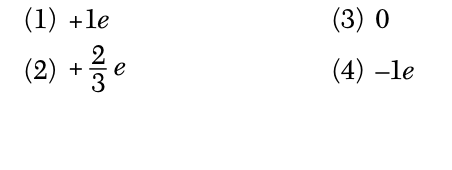
    33 An antiproton has a charge of

    Solution: An antiparticle has the opposite properties as a regular particle. For a proton, the charge is e. So, an antiproton must have -1e. Choice (4)

    34 Two pulses approach each other in the same medium. Which pair of pulses will result in the largest magnitude displacement of the medium as the pulses pass through each other?

    Solution: Both choices 2 and 4 are ideal since the pulses are on the same side. However, the pulse going to the left in choice 2 is slightly more in amplitude so choice 2 should produce the greatest displacement of the medium Choice (2)

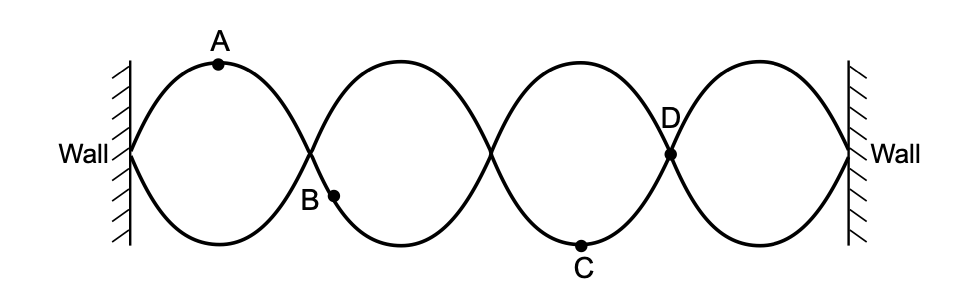
    35 Two waves of the same wavelength interfere to form a standing wave pattern as represented in the diagram below.

    Which point on the diagram represents a node?
    (1) A (3) C
    (2) B (4) D

    Solution: A node is where the displacement of the medium is the smallest. Choice (4)

    Part B–1

    36 A round dinner plate has a diameter closest to
    (1) 2 × 10⁻² m (3) 2 × 100 m
    (2) 2 × 10⁻¹ m (4) 2 × 101 m

    Solution: A dinner plate should have a diameter of a couple of inches. 1 inch = 2.54cm so it should be something around 20cm. Choice (2)

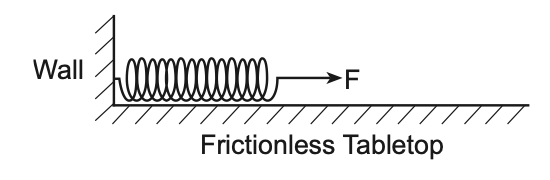
    37 Several springs are lying on frictionless tabletops with one end attached to a wall and a variable force F applied to the free end of each spring. The springs have different spring constants, k. The diagram below shows the setup for one of the springs.

    The elongation of the springs produced by force F depends
    (1) directly on both F and k (3) inversely on F and directly on k
    (2) directly on F and inversely on k (4) inversely on both F and k

    Solution:


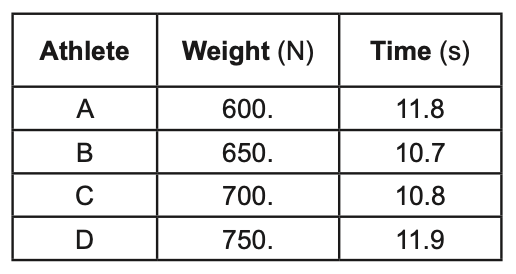
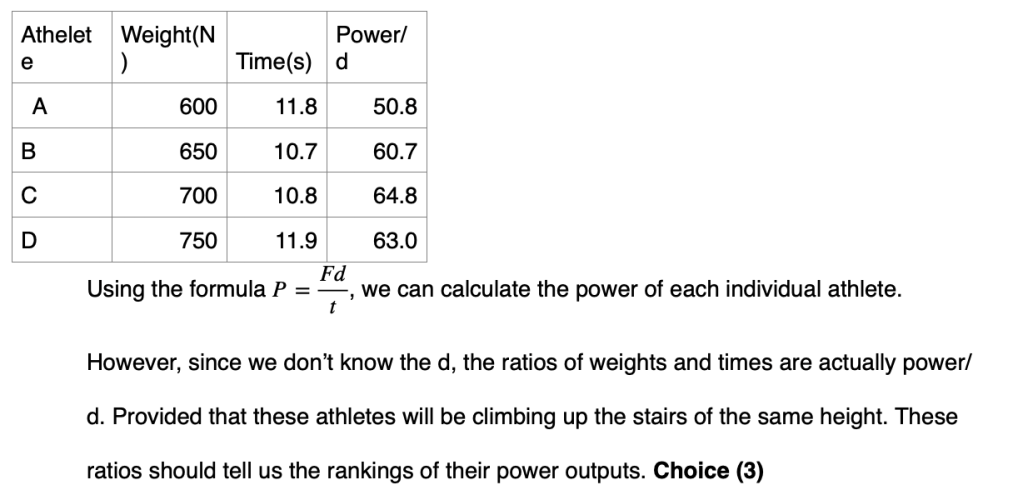
    38 The table below shows the weight of four athletes (A, B, C, and D) and the time required for each athlete to run from the base of a hill to its top

    Which athlete ran up the hill with the greatest average power?
    (1) A (3) C
    (2) B (4) D

    Solution:


    39 A copper wire carries 2.8 amperes of current. The total amount of charge that passes a point in the wire in 1.3 milliseconds is
    (1) 4.6 × 10⁻⁴ C (3) 3.6 C
    (2) 3.6 × 10⁻³ C (4) 2.2 × 10³ C

    Solution:


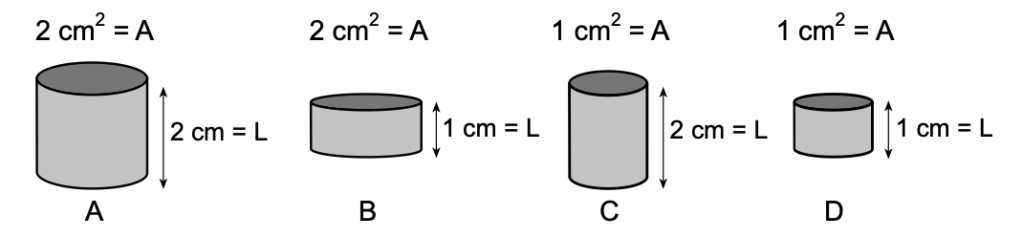
    40 The diagram below represents four solid copper wire segments at 20°C with different lengths (L) and cross -sectional areas (A).

    Which two segments have the same resistance?
    (1) A and B (3) B and C
    (2) B and D (4) A and D

    Solution: Using the formula , we see that the resistance of a piece of wire is proportional to the length and inversely proportional to the cross-sectional area. For cylinder A, we see that it is both twice the length and the cross-sectional area of cylinder D. Therefore, cylinders A and D should have the same resistance. Choice (4)
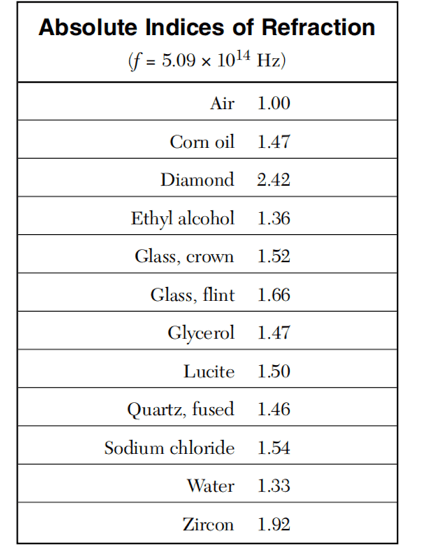
    41 In substance X, a ray of light with a frequency of 5.09 × 10¹⁴ hertz has a speed of 2.04 × 10⁸ meters per second. Substance X could be
    (1) diamond (3) zircon
    (2) water (4) glycerol

    Solution: We know the formula for EM wave in a medium is v=c/n, we can calculate the n, index of refraction, by dividing c by v. n=3*108/2.04*108=1.47. Looking up the reference table, this index of refraction is the same as that of corn oil or glycerol. Choice (4)


    42 Which could not be the charge on a particle?
    (1) 3.2 × 10⁻¹⁹ C (3) 4.8 × 10⁻¹⁹ C
    (2) 4.5 × 10⁻¹⁹C (4) 6.4 × 10⁻¹⁹ C

    Solution: Elementary charge = 1.6*10-19 C, a stable particle must always have the integer multiple of this charge. Choice 2 is the only choice which is an integer multiple of the elementary charge. Choice (2)


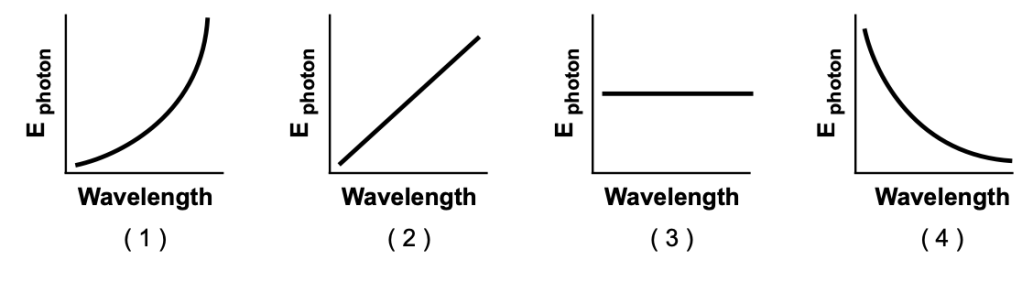
    43 Which graph best represents the relationship between photon energy (Ephoton) and wavelength?

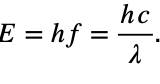
    Solution: Using the formula for the energy of a photon, we know that . This indicates that the energy of a photon is inversely proportional to the wavelength. The graph that shows an inversely proportional relationship is 4. Choice (4)

    44 Light travels from air into another medium with an index of refraction of n. The light has a wavelength of 6.0 × 10⁻⁷ meter in the new medium. Which expression represents the wavelength of this light in air

    Solution: When an EM wave enters a medium, the frequency doesn’t change while the wavelength gets shortened by a factor of the index of refraction. Once the ray comes out of the medium, the wavelength will return to the original by being multiplied by a factor of n. Choice (1)

    45 If 80. joules of electrical energy is dissipated by a 10.-ohm resistor in 2.0 seconds, the current in the resistor is
    (1) 5.0 A (3) 8.0 A
    (2) 2.0 A (4) 4.0 A

    Solution: If the dissipated energy is 80 joules over 2 seconds, the power is 40 W. Using the formula P=IV=I2R, we can find the I. I=2A Choice (2)

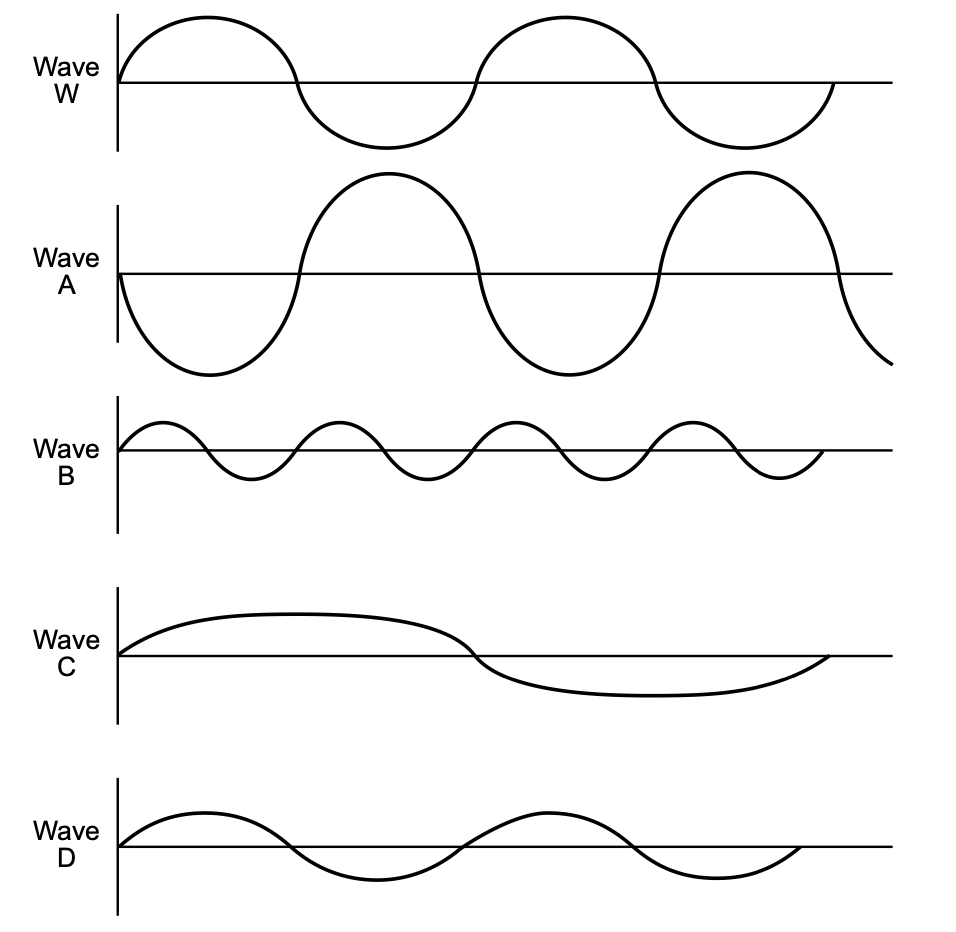
    Base your answers to questions 46 and 47 on the diagrams below, and on your knowledge of physics. The diagrams represent waves W, A, B, C, and D traveling through the same uniform medium.

    46 Which wave has a period that is twice that of wave W?
    (1) A (3) C
    (2) B (4) D

    Solution: Wave W completes two cycles over the length, if there is a wave that has twice the period, it must only complete one cycle over the length. Wave C Choice (3)


    47 Which wave is always 180 degrees out of phase with wave W?
    (1) A (3) C
    (2) B (4) D

    Solution: If a wave is 180 degrees out of phase with wave W, the crest of W must meet the trough of that wave and vice versa. Wave A. Choice (1)

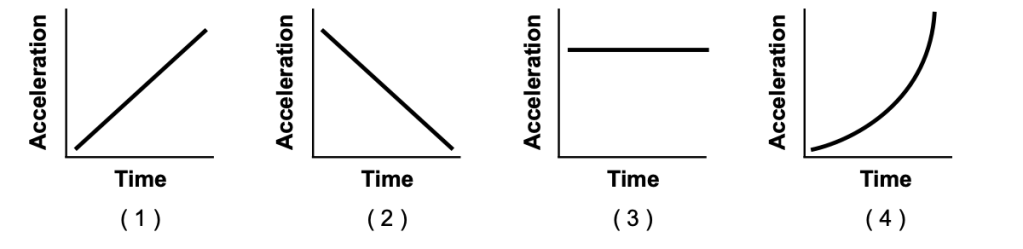
    48 Which graph best represents the relationship between acceleration and time for a freely falling object as the
    object falls near the surface of Earth?

    Solution: Everything that is free falling on this planet (Earth) is subject to a gravitational acceleration of 9.81m/s^2 and it’s constant near the surface of Earth. Choice (3)

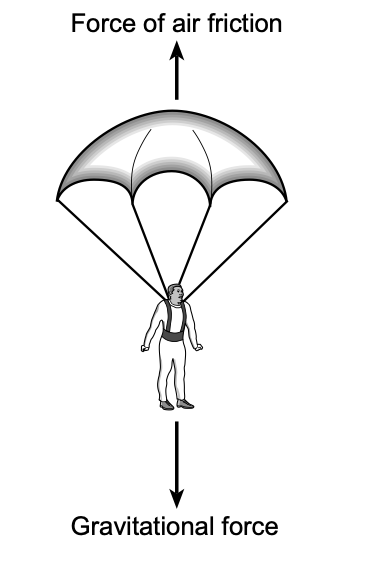
    49 The diagram below represents the forces acting on a skydiver with his parachute.

    The total mass of the skydiver with his parachute is 85.0 kilograms. If the magnitude of the gravitational force is 834 newtons, and the magnitude of the force of air friction is 652 newtons, the acceleration of the skydiver
    at the time shown is
    (1) 2.14 m/s2 up (3) 7.67 m/s2 up
    (2) 2.14 m/s2 down (4) 9.81 m/s2 down

    Solution: Using Newton’s 2nd law, we know that Fnet=ma. In this case, Fnet=834-652=182N. Given that the mass of the skydiver is 85kg, we can calculate the acceleration by a=182N/85kg= 2.14 m/s2 down Choice (2)


    50 A 15.0-gram air hockey puck sliding on a horizontal surface at a velocity of 7.00 meters per second north collides with a 15.0-gram air hockey puck traveling at a velocity of 8.00 meters per second south. The momentum of the system of pucks after the collision is
    (1) 0.0150 kg•m/s north (3) 0.225 kg•m/s north
    (2) 0.0150 kg•m/s south (4) 0.225 kg•m/s south

    Solution: The total momentum of the system should be conserved after the collision so as long as we can calculate the total momentum of the system before the collision, we should be able to answer the question. Let’s take the north to be positive, Ptotal=0.015kg*7m/s-0.015kg*8m/s=  -0.015kg*m/s. So the total momentum is to the south. Choice (2)

    SHORT RESPONSE ANSWERS

  • Physics Regents Exam June 2024

    Physics Regents Exam June 2024

    Questions and Solution With Clear Explanations

    1 Which quantity is a vector?
    (1) electric field
    (2) electric potential difference
    (3) electric charge
    (4) electric power


    Solution: A vector quantity must have both directions and magnitude. Although electric potential difference, electric charge and electric power can be positive or negative depending on the case, they cannot be pointed towards a specific direction such as 20 degrees above the x-axis. Therefore, the only choice is electric field. Choice (1)


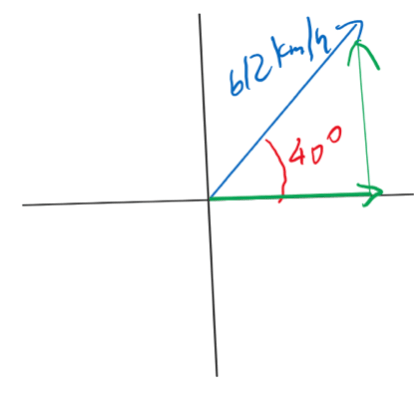
    2 What is the magnitude of the eastward component of the velocity of an airplane flying at 612 kilometers per hour in a direction 40.0° north of east?
    (1) 393 km/h (3) 799 km/h
    (2) 469 km/h (4) 952 km/h
    Solution:

    612*cos40=469km/h Choice (2)


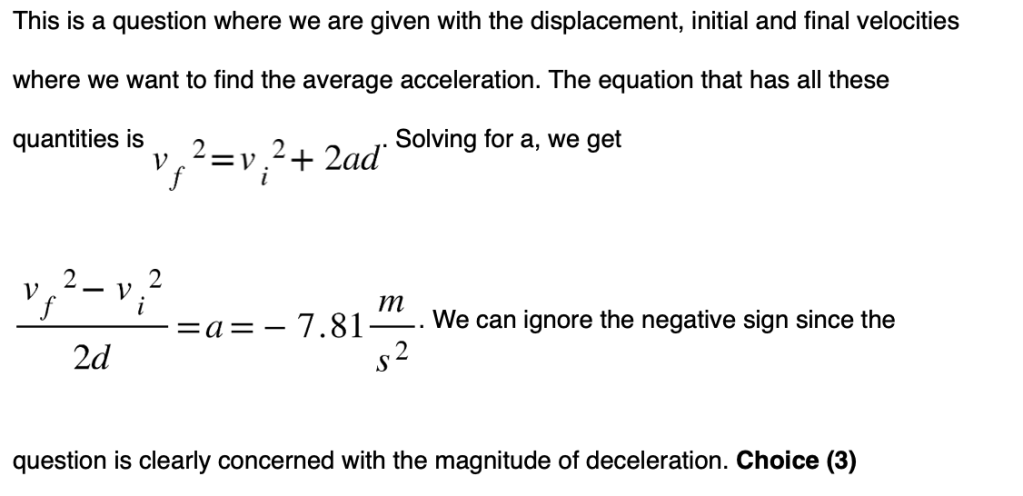
    3 A car, initially traveling at 25 meters per second, is uniformly brought to rest as the brakes are applied over a distance of 40. meters. The magnitude of the average acceleration of the car while braking is
    (1) 0.31 m/s2
    (3) 7.8 m/s2
    (2) 0.63 m/s2
    (4) 16 m/s2
    Solution:


    4 A brick starts from rest and falls freely from the top of a building to the ground. As the brick falls, its acceleration
    (1) increases and its speed increases
    (2) increases and its speed is constant
    (3) is constant and its speed increases
    (4) is constant and its speed is constant
    Solution: As everything that is free-falling on this planet, the brick would experience a downward acceleration of 9.8m/s^2. Since it was dropped instead of tossed up, the speed should be constantly increasing at a rate of 9.8m/s^2. Choice (3)

    5 Which object has the greatest inertia?
    (1) a 0.10-kg baseball traveling at 30. m/s
    (2) a 70-kg sprinter traveling at 10. m/s
    (3) a 1000-kg car traveling at 50. m/s
    (4) a 2000-kg truck traveling at 20. m/s
    Solution: The word “inertia” practically means the tendency to resist being changed. In this context, the more massive an object is, the bigger the inertia. Choice (4)

    6 An unbalanced force is always necessary to
    (1) keep a body at rest
    (2) keep a body moving with constant velocity
    (3) change the speed of a body
    (4) change the position of a body

    Solution: According to Newton’s 2nd law, Fnet=ma. If there is an unbalanced force, Fnet is not going to be zero and therefore there will be an acceleration. Once there is an acceleration, there must be a change in either direction or magnitude of the velocity (speed). Choice (3)

    7 Space probes launched from Earth send information back to Earth from space in the form of
    (1) mechanical waves
    (2) sound waves
    (3) longitudinal waves
    (4) electromagnetic waves
    Solution: Space probes require radio waves to communicate with the people on Earth, radio waves are a part of the spectrum of the EM waves. Choice (4)

    8 A ball is thrown from level ground at an angle of 55° above the horizontal and lands on level ground. Neglecting friction, if the ball is thrown again at the same angle but with a larger initial speed, the ball will travel
    (1) higher and the same distance horizontally
    (2) to the same maximum height and farther horizontally
    (3) both higher and farther horizontally
    (4) to the same maximum height and the same distance horizontally

    Solution: The range of a projectile only depends on two things: initial velocity and the angle it makes with the horizontal. Once the initial velocity is increased, the range will be increased. As for the maximum height, it depends on the initial vertical component of the velocity so it will be increased as well.  Choice (3)

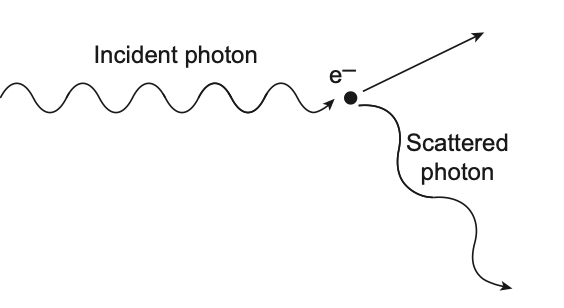
    9 A photon collides with an electron, as represented in the diagram below

    After the collision, the electron recoils and the photon is scattered in another direction with a longer wavelength than the incident photon. The increase in photon wavelength results because, during the collision, the photon
    (1) loses energy to the electron
    (2) gains momentum from the electron
    (3) loses some speed
    (4) generates a magnetic field

    Solution:

    10 What is the weight of a 60.0-kilogram student on the surface of Earth?
    (1) 0.164 N (3) 60.0 N
    (2) 6.12 N (4) 589 N
    Solution:

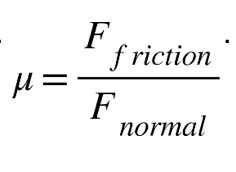
    11 A 120-newton box is pulled by a 48-newton horizontal force across a horizontal surface at constant velocity. The coefficient of kinetic friction between the box and the horizontal surface is
    (1) 0.041 (3) 0.67
    (2) 0.40 (4) 2.5
    Solution:. Since the problem states that the box is being moved at a constant speed over a horizontal surface, we know that Fnormal = Weight = 120N and Ffriction = Fapplied = 48. µ=48N/120N= 0.4.  Choice (2)


    12 Box A has a mass of 10. kilograms and is at rest on a shelf that is 1.5 meters above the floor. Box B has a mass of 20. kilograms and is at rest on a shelf that
    is 3.0 meters above the floor. Compared to box A, box B has a gravitational potential energy relative to the floor that is
    (1) one fourth as great (3) twice as great
    (2) the same (4) four times as great
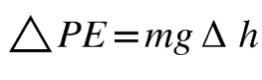
    Solution:. If an object is twice as massive and twice as high compared to another object, it will have 4 times as much of gravitational potential energy. Choice (4)


    13 A 0.10-kilogram yo-yo is whirled at the end of a length of string in a horizontal circular path of radius 0.80 meter at a speed of 6.0 meters
    per second. The magnitude of the centripetal acceleration of the yo-yo is
    (1) 4.5 m/s
    (3) 23 m/s2
    (2) 7.5 m/s2
    (4) 45 m/s2

    Solution:


    14 A 4.0-kilogram mass is initially at rest on a horizontal, frictionless surface. A constant 2.0-newton force to the east is applied to the mass for a 5.0-second interval. As a result of this action, the mass acquires a
    (1) velocity of 10. m/s, east
    (2) velocity of 10. m/s, west
    (3) momentum of 10. kg•m/s, east
    (4) momentum of 10. kg•m/s, west

    Solution:

    The answer is obtained by multiplying 2N*5s=10Ns in the same direction as the force so to the east. Choice (3)


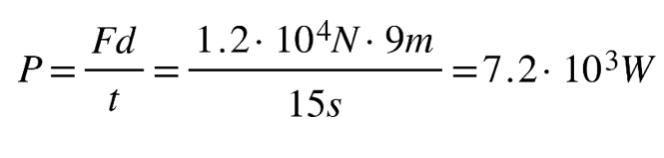
    15 A motor lifts a 1.2 × 10⁴-newton elevator 9.0 meters in 15 seconds. The minimum power output of the motor is
    (1) 8.0 × 10² W (3) 1.0 × 10⁵ W
    (2) 7.2 × 10³ W (4) 1.6 × 10⁶ W

    Solution: If the question is asking for the minimum power, the force exerted by the motor should be equal to the weight of the mass to be lifted. Choice (2)

    16 A train blows its horn, which emits a uniform sound as the train approaches a stationary observer. The observer hears a sound that has a
    (1) lower frequency than the emitted sound and is decreasing in amplitude
    (2) lower frequency than the emitted sound and is increasing in amplitude
    (3) higher frequency than the emitted sound and is decreasing in amplitude
    (4) higher frequency than the emitted sound and is increasing in amplitude
    Solution: If a train is approaching an observer while blowing its horn, the frequency will appear to be higher as the train’s horn’s frequency undergoes Doppler effect. Since the loudness(amplitude) of the sound is inversely proportional to the distance squared, the amplitude will increase as the train approaches the observer.  Choice (4)
    17 A wood block is pulled at constant velocity across a horizontal wood floor. Which type of energy increases in this block-floor system as the block
    moves?
    (1) gravitational potential (3) mechanical
    (2) kinetic (4) thermal

    Solution:As a piece of wood is pulled across the horizontal floor at a constant speed, it must mean that there is a friction force that is there to balance the applied force so that there is no acceleration. The friction between the floor and the wood will create heat energy. Choice (4)
    18 A total energy of 5.0 joules is used to move an electron from position A to position B in a uniform electric field. What is the potential difference
    between positions A and B?
    (1) 3.1 × 10¹⁹ V (3) 3.2 × 10⁻²⁰ V
    (2) 8.0 × 10⁻¹⁹ V (4) 3.1 × 10¹⁸ V
    Solution:


    19 A 0.14-kilogram lacrosse ball, traveling west at 17 meters per second, is brought to rest with a 0.21-kilogram lacrosse stick. If the force applied by the lacrosse stick on the ball is 220 newtons east, the force applied by the ball on the stick is
    (1) 150 N east (3) 220 N east
    (2) 150 N west (4) 220 N west

    Solution: According to Newton’s 3rd law, the action and reaction forces should be equal but opposite. If the action force is 220N to the east, the reaction must be 220N to the west. Choice (4)


    20 Four wires are tested for electrical conductivity. All the wires have the same length and the same cross-sectional area, but are made of different
    metals. Which wire has the highest conductivity at 20°C?
    (1) aluminum (3) gold
    (2) copper (4) silver

    Solution: Conductivity and resistivity are reciprocals of each other. Since silver has the lowest resistivity, it must have the highest conductivity. Choice (4)

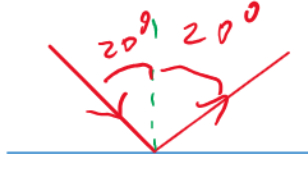
    21 The angle of incidence for a ray of light striking a plane mirror is 20º. What is the angle between the incident ray and the reflected ray?
    (1) 20º (3) 70
    (2) 40º (4) 90
    Solution: The ray will always be reflected at the same angle as the incident angle. So the angle of separation between the incident and the reflected rays is 40 degrees. Choice (2)

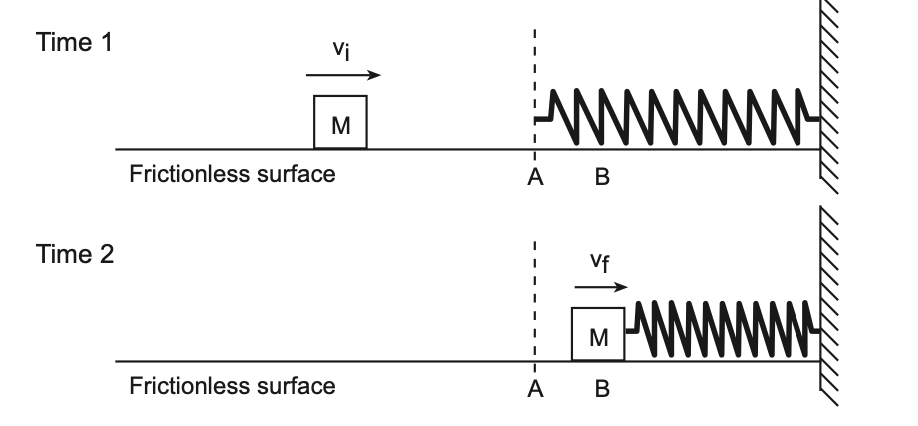
    22 As shown in the diagram below, mass M slides across a level, frictionless surface with speed vi. The mass strikes a spring at position A, causing the spring to compress. When the mass is at position B, it is moving at a slower speed, vf.

    Which statement best describes the energy conversion as the mass moves from position A to position B?
    (1) Some of mass M’s kinetic energy is converted to elastic potential energy.
    (2) All of mass M’s kinetic energy is converted to elastic potential energy.
    (3) Some of mass M’s kinetic energy is converted to gravitational potential energy.
    (4) All of mass M’s kinetic energy is converted to internal energy.
    Solution: As the mass is compressing the spring, it will slow down and whatever kinetic energy that is lost will be converted into the elastic potential energy of the spring.  Choice (1)


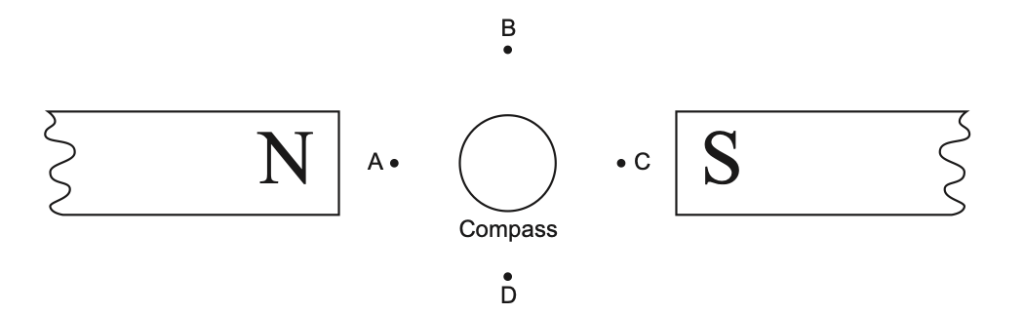
    23 The diagram below shows a magnetic compass placed between unlike magnetic poles.

    The north pole of the compass needle will point toward
    (1) A (3) C
    (2) B (4) D
    Solution: A compass needle will always point towards the direction of the magnetic south pole so it will point towards point C. Choice (3)


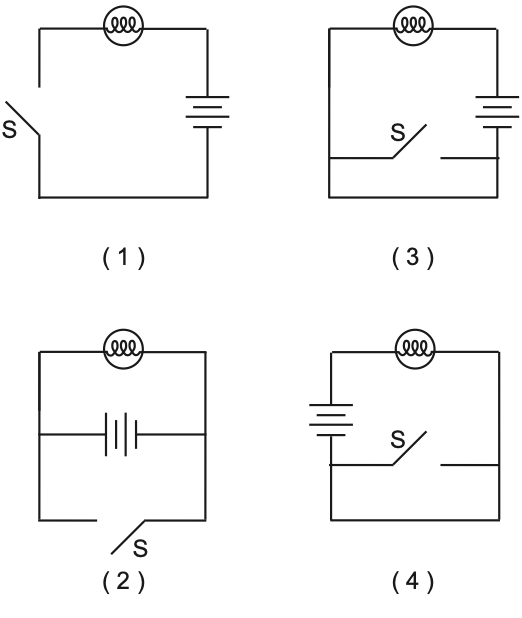
    24 Which circuit diagram contains a lamp that will not have current passing through it until switch S is closed?

    Solution: For diagram 1, you cannot have an unbroken path between the battery and the lamp unless the switch has been closed so that is the only choice. Choice (1)

    25 The diagram below represents an electric circuit.

    Solution: 

    26 An object is thrown vertically upward with an initial velocity of 9.81 meters per second. What is the maximum height reached by the object?
    [Neglect friction.]
    (1) 1.00 m (3) 9.81 m
    (2) 4.91 m (4) 19.6 m

    Solution: We know that the object momentarily comes to rest at the maximum height so vf=0. Let a=-9.81m/s^2, we can solve that the d=4.91m Choice (2)


    27 Which type of photon has the least amount of energy?
    (1) ultraviolet (3) infrared
    (2) visible light (4) radio

    Solution:

    based on this diagram, the radio waves have the lowest frequency so the photons of radio waves must have the lowest energy.  Choice (4)

    28 A 7.5-kilogram object moving at 20. meters per second strikes a 60.-kilogram object initially at rest on a horizontal, frictionless surface. The two objects stick together and move off at a speed of
    (1) 0.33 m/s (3) 2.5 m/s
    (2) 2.2 m/s (4) 18 m/s

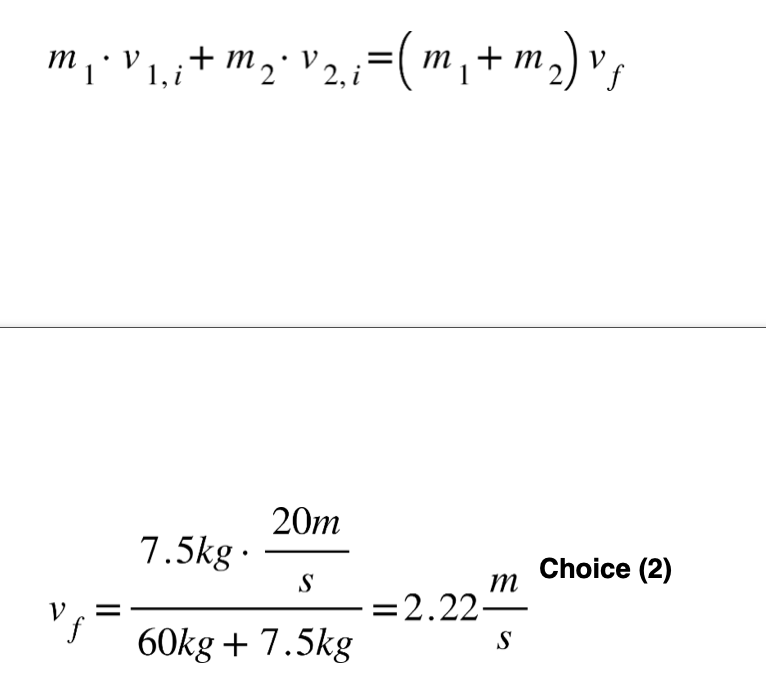
    Solution: Using the principle of conservation of momentum, we can derive the formula for the momenta of the objects before and after the collision as

    Choice (2)


    29 How is the electrostatic force between two positive charges affected as the charges are brought closer together?
    (1) The force of attraction between them increases.
    (2) The force of repulsion between them increases.
    (3) The force of attraction between them decreases.
    (4) The force of repulsion between them decreases.
    Solution:

    The same charges always repel each other, as they are brought closer to each other, the force of repulsion increases. Choice (2)


    30 What is one difference between magnetic forces and gravitational forces?
    (1) Magnetic forces are always attractive, whereas gravitational forces are always repulsive.
    (2) Magnetic forces are always repulsive, whereas gravitational forces are always attractive.
    (3) Magnetic forces may be attractive or repulsive, whereas gravitational forces are always attractive.
    (4) Magnetic forces may be attractive or repulsive, whereas gravitational forces are always repulsive.
    Solution: The gravitational force is always attractive because we cannot have negative mass in the physics we know so far. However, the magnetic force can be either attractive or repulsive because the same poles repel, and opposite poles attract. Choice (3)

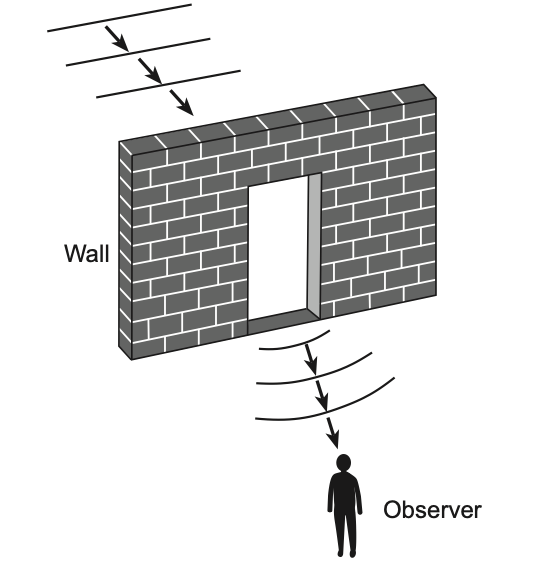
    31 A sound wave passes through an opening in a brick wall as represented in the diagram below.

    An observer standing behind the wall is able to hear the sound. This spreading out of the sound wave as it passes through the opening is an example of
    (1) interference (3) refraction
    (2) reflection (4) diffraction

    Solution: Diffraction is a phenomenon where waves can spread around obstacles. Choice (4)

    32 A sound wave is emitted by a vibrating tuning fork.
    What is transferred as the sound wave travels to a student’s ear?
    (1) mass, only
    (2) energy, only
    (3) both mass and energy
    (4) neither mass nor energy

    Solution: Sound is a longitudinal wave where a group of air molecules become compressed or rarified (having low pressure), only packets of energy are travelled along with the wave instead of the matter (air molecules). Choice (2)

    33 An electric current passing through a copper wire at constant temperature would result in
    (1) an increase in the resistivity of the wire
    (2) a decrease in the resistivity of the wire
    (3) the emission of protons from the wire
    (4) the production of a magnetic field around the wire
    Solution: Using the right hand rule, we know that there must be a magnetic field induced around a current-carrying wire (make a hitchhiker’s sign with your right hand, the thumb is the direction of the current while the rest of the fingers will be the direction of the magnetic field induced by the current). Choice (4)

    34 The velocity of an object in uniform circular motion has a
    (1) constant magnitude and changing direction
    (2) constant magnitude and constant direction
    (3) changing magnitude and constant direction
    (4) changing magnitude and changing direction

    Solution: In a uniform circular motion, the velocity’s direction is constantly being changed by the centripetal acceleration while maintaining its magnitude hence the word “uniform”. Choice (1)


    35 Tuning fork A starts to vibrate at 320 hertz when it is held near tuning fork B, already vibrating at 320 hertz. Which phenomenon is exemplified by
    the action of tuning fork A?
    (1) the Doppler effect (3) diffraction
    (2) resonance (4) refraction

    Solution: When an object is being vibrated close to its natural frequency of vibration, it will start vibrating with increasing amplitude at this frequency. This phenomenon is called resonance. Look up Tacoma Narrow Bridge collapse online for a video of this phenomenon. Choice (2)

    Part B–1

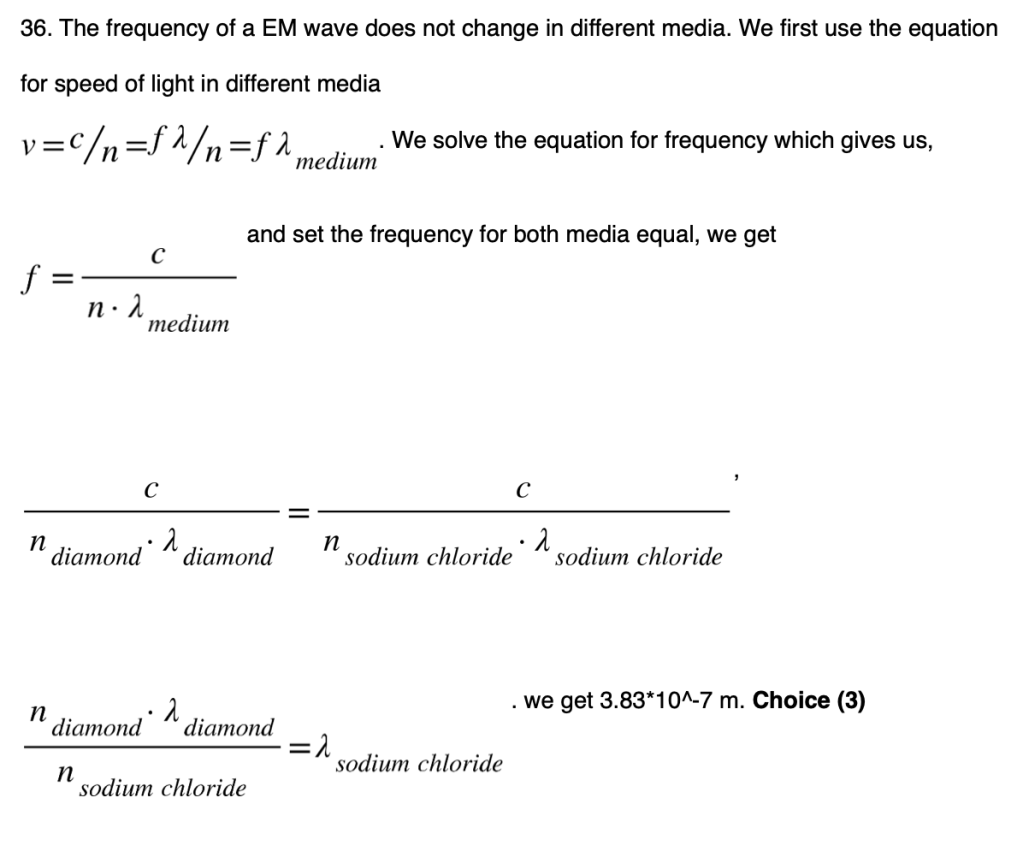
    36 A light ray with a frequency of 5.09 × 10¹⁴ hertz has a wavelength of 2.44 × 10⁻⁷ meter in diamond. The wavelength of this light ray in sodium chloride is
    (1) 1.55 × 10⁻⁷ m (3) 3.83 × 10⁻⁷ m
    (2) 2.44 × 10⁻⁷ m (4) 5.89 × 10⁻⁷ m

    Solution:

    37 The diagram below shows resistors R1, R2, and R3 connected to a 12-volt source.

    The current flowing through resistor R3 is
    (1) 5.0 A (3) 0.50 A
    (2) 2.0 A (4) 0.20 A

    Solution:The resistors are in series so they must all have the same current passing through them. Using Ohm’s law, we have V=IR. The total resistance of the whole circuit is 15+21+24=60Ω. The current can then be calculated as I=12V/60Ω=0.2A. Choice (4)

    38 A charge of 25 coulombs moves past a point in a circuit in 2.5 seconds. What is the current at that point in the circuit?
    (1) 0.10 A (3) 50. A
    (2) 10. A (4) 63 A

    Solution: Using the formula I=∆q/t, we can calculate the current by I=25C/2.5s = 10A Choice (2)

    39 Which statement describes an object with constant kinetic energy?
    (1) A car accelerates along a straight road.
    (2) A runner decreases her speed along a curved path.
    (3) A bicycle travels around a curve at constant speed.
    (4) A sled travels down a frictionless, steep, straight hill.
    Solution: The premise of maintaining constant kinetic energy is that the speed cannot change since the formula for kinetic energy is . Choice (3)

    40 Which phrase describes a box in equilibrium?
    (1) box in an elevator slowing down as it rises vertically
    (2) box at rest on a stationary table
    (3) box sliding down a frictionless ramp
    (4) box in free fall
    Solution: For something to be in equilibrium, we must have no unbalanced force. When there is no unbalanced force, the object must either be stationary or moving at constant velocity (not speed). Choice (2)

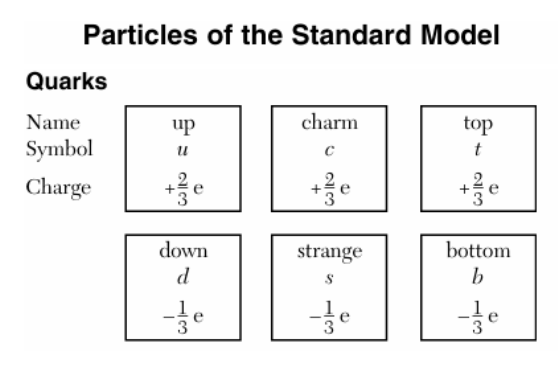
    41 Quarks may combine to produce a meson of charge

    Solution: By definition, a meson is made of a quark and an anti-quark. Since a quark and its anti quark will have the opposite charges, the only possible outcome for the total charge is 0. Choice (4)

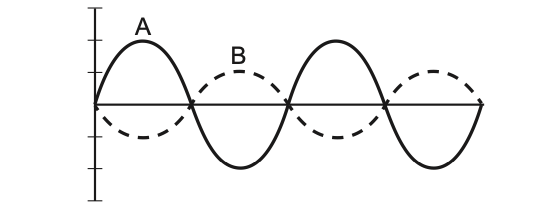
    42 The diagram below shows waves A and B as they travel through a region in the same medium.

    Which wave best represents the superposition of waves A and B?

    Solution: The diagram shows that waves A and B are out of phase as in the trough of B matches with the crest of A. However, the amplitude of B is smaller than A. The result of the superposition will result a wave looking like wave A with a reduced amplitude. Choice (3)

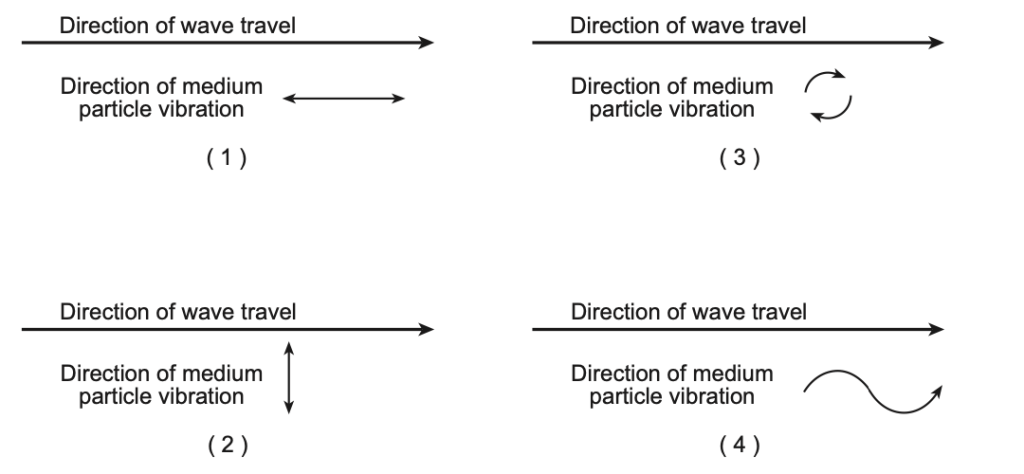
    43 The diagrams below show the direction of wave travel and the direction of medium particle vibration for different waves. Which diagram best represents the characteristics of a sound wave?

    Solution: Sound wave is a longitudinal wave. A longitudinal wave will behave such that the direction of wave traveling is the same as the direction of particles’ vibrations. Choice (1)

    44 In a sample of gas, many excited hydrogen atoms are in the n = 4 energy level. What is the maximum number of different photon energies that can be emitted by these atoms as they return to the ground state?
    (1) 6 (3) 3
    (2) 5 (4) 4

    Solution:There are a couple of different ways for a particle at n=4 to decay down to n=1. We can go n=4->n=1, n=4->n=3, n=3->n=2,n=2->n1,n=3->n=1,n=4->n=2. So there are six different routes the particle can take to decay and each route represents a photon of different energy Choice (1)


    Base your answers to questions 45 and 46 on the information below and on your knowledge of physics.
    Two students did an experiment to measure the acceleration of a freely falling object. One student dropped an object from rest. The other student measured the distance fallen by the object and the corresponding time of fall. The data for the dropped object are shown below.

    distance fallen by object = 2.4 meters
    time of fall = 0.71 second

    45 Based on the data for the dropped object, the experimental value calculated for the object’s acceleration is
    (1) 11 m/s2
    (2) 9.5 m/s2
    (3) 6.8 m/s2
    (4) 4.8 m/s2

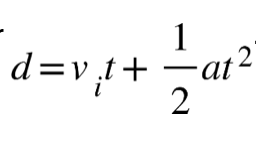
    Solution: Use the formula above. Let d=2.4m and vi=0 and t=0.71s, we solve a=9.5m/s^2. Choice (2)

    46 The ideal value for the acceleration differs from the one obtained experimentally by the students. What is one possible cause of this discrepancy?
    (1) The object was given some initial horizontal velocity.
    (2) The force of gravity was much stronger outside the building than inside.
    (3) Motion formulas should not be used in an experimental setting.
    (4) There may have been errors in the measurement of distance and/or time.

    Solution: Choices 2 and 3 are simply too ridiculous to be taken seriously. Choice 1 is wrong as well since the time to free fall is not affected by the horizontal component of the initial velocity. Choice (4)

    47 Which graph represents the motion of an object falling freely from rest near the surface of the Moon?

    Solution: Based on the motion formula, d is proportional to t squared. The graph should have the same characteristics of the graph of y=x^2. Choice (3)

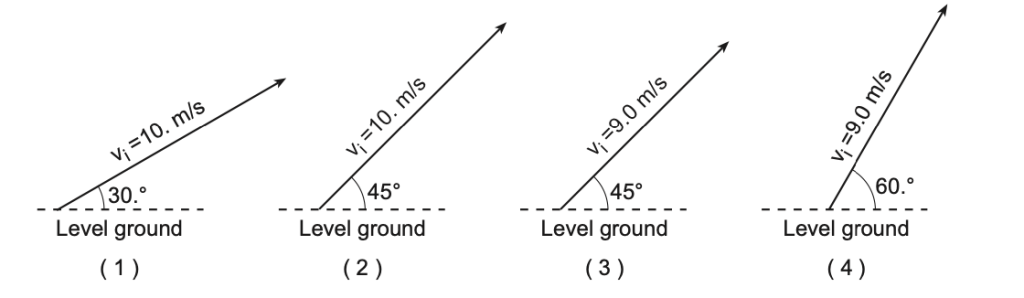
    48 The diagrams below represent the initial velocities, vi, of four identical projectiles launched from level ground at various angles above the horizontal. Which projectile will have the longest time of flight? [Neglect friction.]

    Solution: Time of flight is dependent on the initial vertical component of the velocity. The diagram 4 should have the biggest initial vertical component. Choice (4)

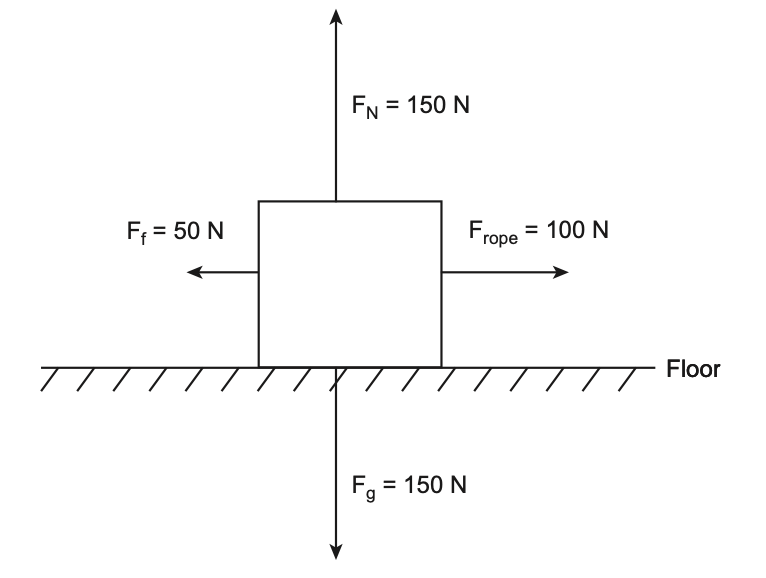
    49 Four forces act on a crate on a level floor, as shown in the diagram below.

    At the instant shown, the crate is
    (1) accelerating to the right (3) moving at constant velocity to the right
    (2) accelerating to the left (4) remaining at rest
    Solution: After summing up the forces along the vertical and horizontal directions, we see that there is an unbalanced force of 50N to the right. So the acceleration is to the right. Choice (1)

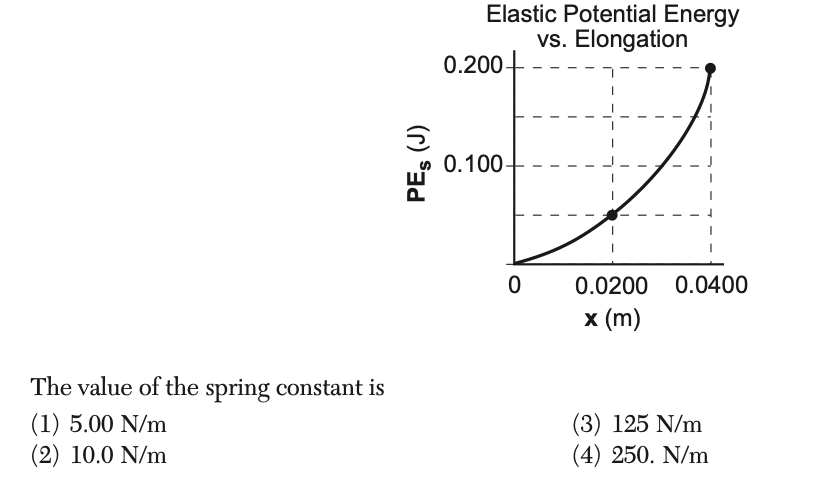
    50 The graph below represents the relationship between the potential energy stored in a spring, PEs, and the elongation of the spring, x.

    Solution: Using the formula. Using the values of x=0.04m and PE=0.2J, we get k=250N/m Choice (4)

    Short Response Answer Can Be Found HERE

  • Hello World!

    Welcome to WordPress! This is your first post. Edit or delete it to take the first step in your blogging journey.